
Epoxy Flooring in Dubai
Professional Epoxy Floor Installation | Residential & Commercial | Dubai, UAE
What Is Epoxy Flooring?
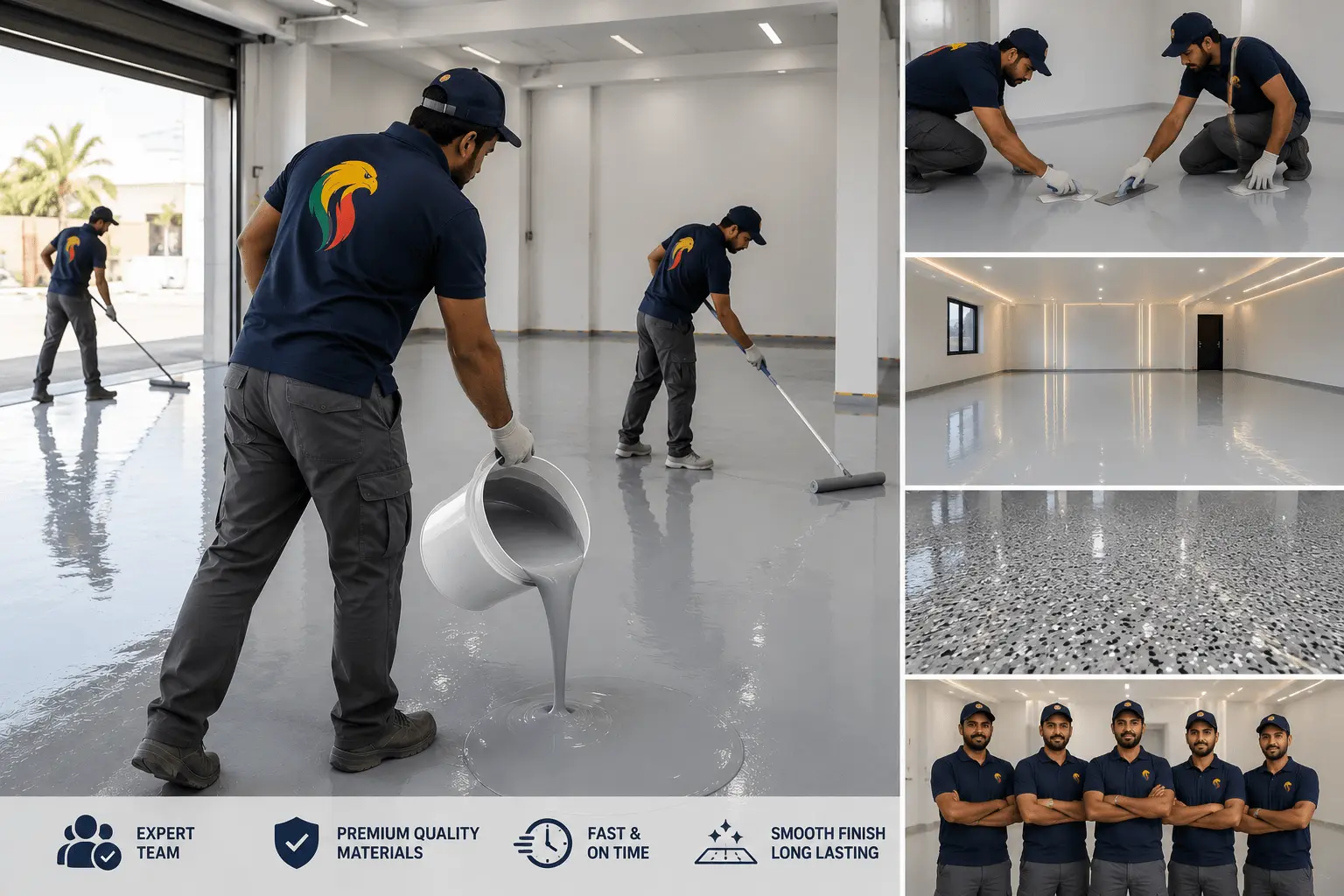
Epoxy flooring is a floor coating system created by combining an epoxy resin with a chemical hardener. When mixed and applied to a prepared concrete substrate, the two components react chemically and cure into a rigid, seamless, highly durable surface that bonds tightly to the concrete below.
The result is a floor that is significantly more durable and easier to maintain than bare concrete — resistant to abrasion, chemicals, staining, and surface damage. Epoxy flooring is widely used across Dubai in garages, warehouses, factories, commercial kitchens, offices, showrooms, clinics, and residential spaces where a clean, durable, and low-maintenance floor is required.
Why Epoxy Flooring Is a Popular Choice in Dubai
Dubai’s commercial and residential environment places demanding requirements on floors — heat, dust, heavy traffic, frequent cleaning, and the need for a professional appearance. Epoxy flooring addresses these requirements in ways that alternatives such as bare concrete, tiles, or conventional floor paint often cannot.
High Durability
A correctly installed epoxy floor resists impact, abrasion, and heavy foot and vehicle traffic. For commercial and industrial environments where the floor takes daily punishment, durability is a practical requirement.
Easy Maintenance
The seamless, non-porous surface means spills stay on the surface rather than penetrating the substrate. Cleaning is straightforward — sweep, mop, or machine-clean without concern about grout lines or porous surfaces that collect dirt and bacteria.
Chemical & Stain Resistance
Industrial and commercial epoxy systems resist oils, fuels, cleaning chemicals, and many common solvents — making epoxy flooring appropriate for workshops, garages, kitchens, and environments where chemical contact is likely.
Seamless Appearance
Epoxy creates a continuous surface without joints, grout lines, or seams. This matters for hygiene in food preparation and clinical environments, and creates a clean, modern appearance in showrooms and offices.
Customisable Finish
Available in a wide range of colours and finishes — from solid colours to metallic, flake, and decorative systems — allowing the floor to complement the environment rather than simply cover the concrete.
Suited to Dubai Conditions
For interior environments, epoxy performs well in Dubai’s conditions. Proper surface preparation accounts for Dubai’s concrete conditions — including residual moisture, contamination, or surface irregularities common to older substrates.
Get a Free On-Site Epoxy Flooring Assessment
No quotation is issued without visiting the site. We assess your floor, identify preparation requirements, and specify the system that actually suits your conditions.
Our Epoxy Flooring Services in Dubai
Epoxy Floor Coating
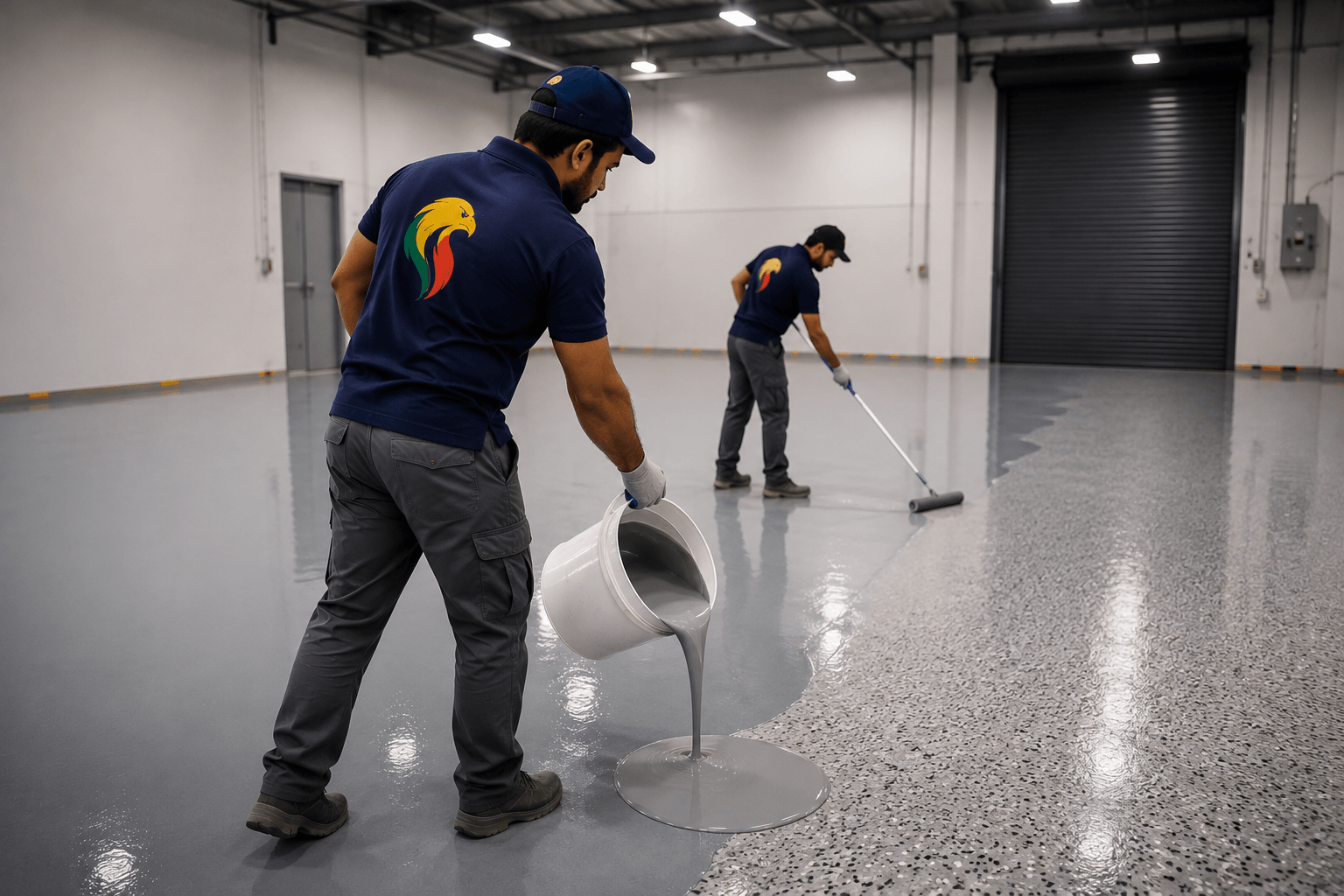
Standard high-build epoxy system applied to a prepared concrete substrate — primer coat, body coat, and topcoat. Protective and durable; appropriate for most commercial and light-industrial applications. Coating thickness and layers depend on intended use.
Self-Leveling Epoxy Flooring
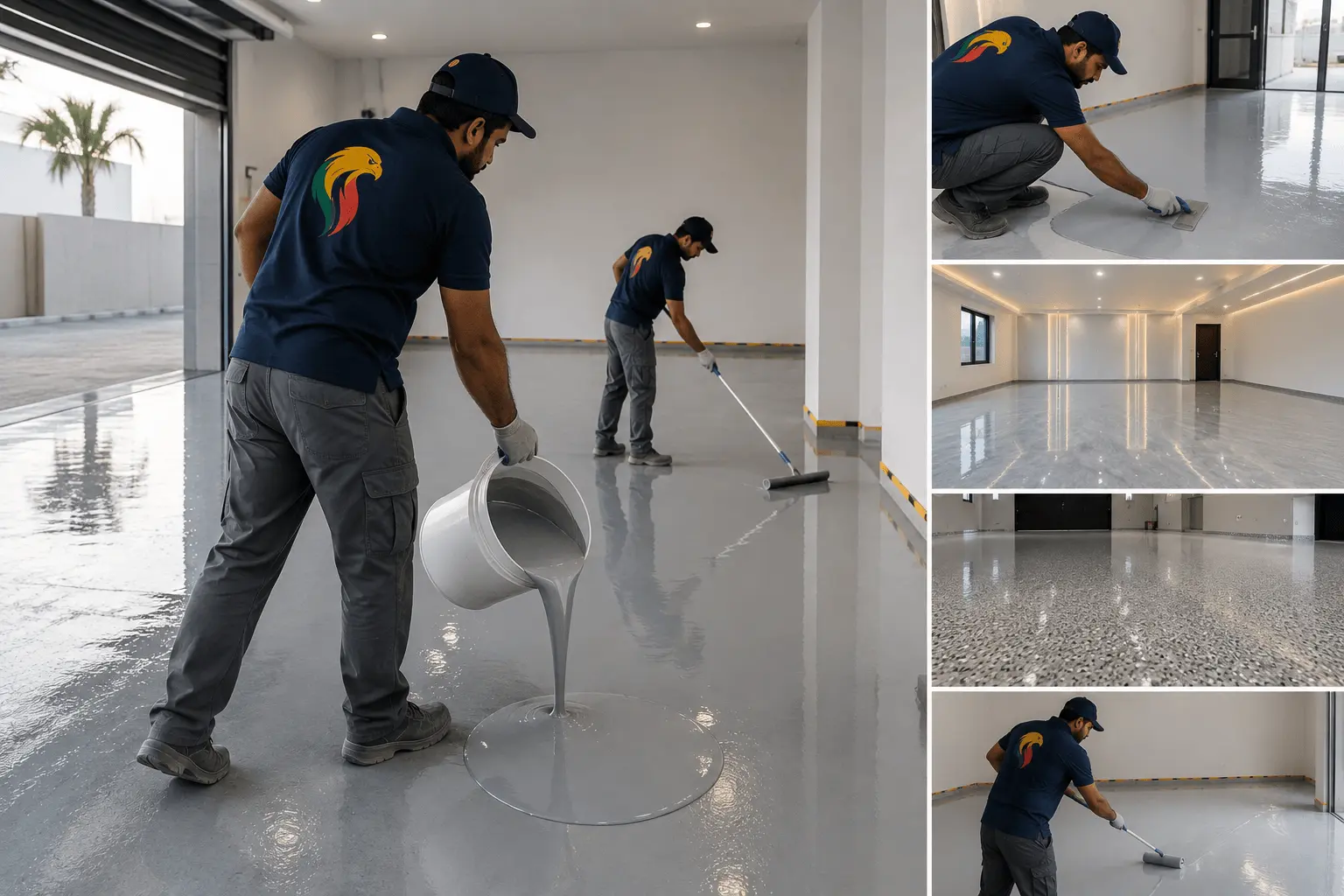
Fluid-consistency system that flows across the prepared substrate and levels to a smooth, flat surface. Ideal for offices, showrooms, retail spaces, and commercial kitchens. The poured application creates a uniform surface difficult to achieve with roller-applied systems.

Industrial Epoxy Flooring
Factories, production areas, workshops, warehouses, and heavy vehicle areas require epoxy systems designed for sustained mechanical loads, chemical exposure, and heavy traffic. Applied at higher thicknesses, with systems selected for the specific requirements of each facility.

Garage Epoxy Flooring
One of the most requested residential applications in Dubai. A garage floor faces oil drips, fuel spills, vehicle traffic, and heat from outside. A flake or solid-colour coating with UV-stable topcoat provides a surface that cleans easily, resists staining, and improves the appearance of the space.

Commercial Epoxy Flooring
Offices, retail stores, restaurants, clinics, salons, and hospitality spaces require a floor that looks professional, withstands daily cleaning, and needs no frequent maintenance. Self-leveling and decorative systems accommodate the scheduling requirements of operating businesses — including after-hours and phased installation.

Decorative Epoxy Flooring
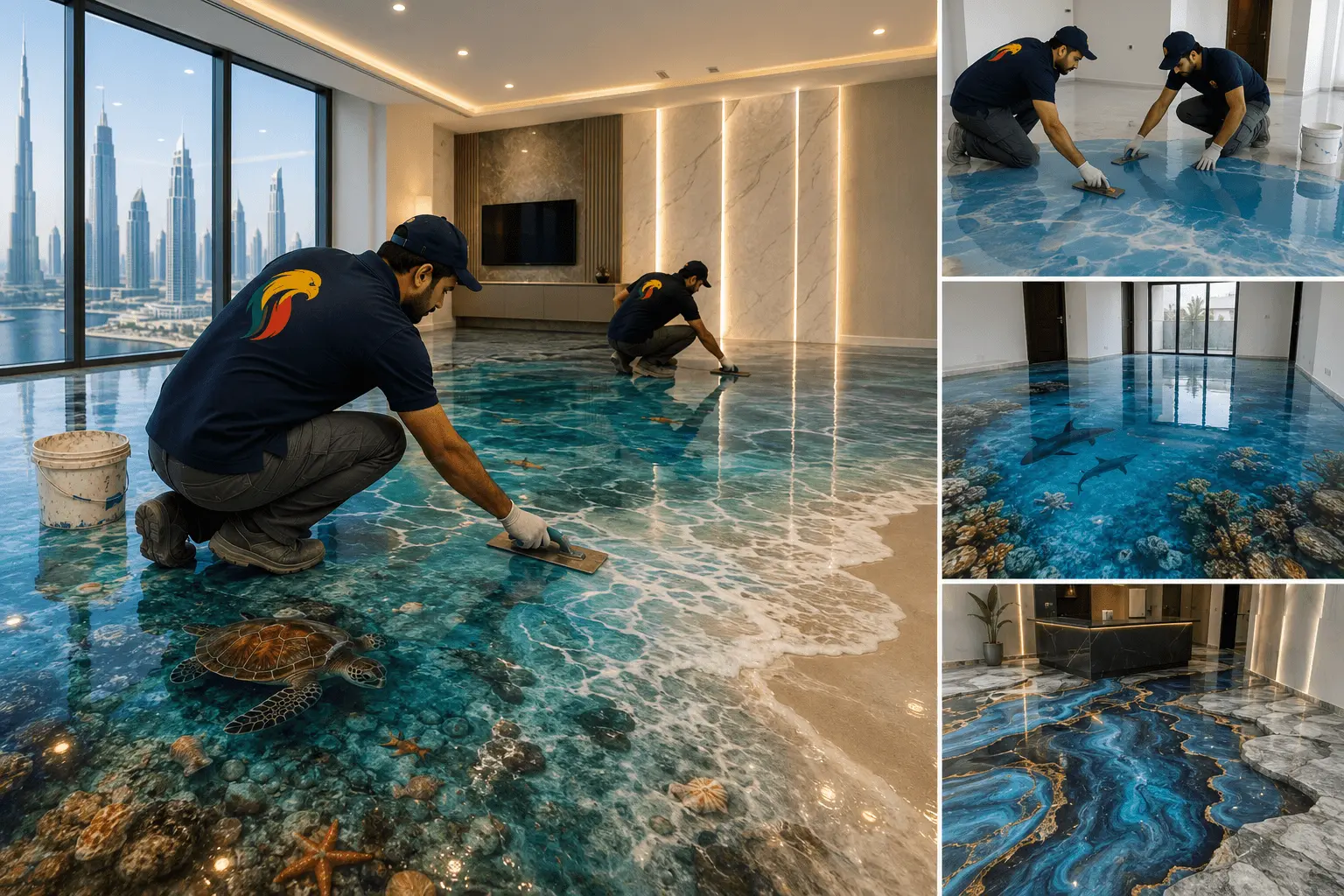
Metallic epoxy, flake systems, and tinted finishes provide floors that function as a design feature. Metallic epoxy creates a unique three-dimensional visual effect; flake systems provide a textured appearance; solid-colour gloss creates a contemporary look. Used in showrooms, reception areas, and residential spaces where appearance matters.
Types of Epoxy Flooring Available in Dubai
The appropriate epoxy system for any project depends on the substrate condition, intended use, traffic type, and environment. Final system selection should always be based on a site assessment.
| Epoxy Type | Best For | Main Benefit |
|---|---|---|
| Epoxy Coating | General commercial floors | Durable protective layer |
| Self-Leveling Epoxy | Offices & showrooms | Smooth, seamless finish |
| Industrial Epoxy | Factories & warehouses | Heavy-duty performance |
| Garage Epoxy | Garages & parking areas | Oil/stain resistance, easy cleaning |
| Metallic Epoxy | Luxury interiors & showrooms | Decorative 3D appearance |
| Flake Epoxy | Garages & commercial spaces | Texture and visual appeal |
| Anti-Slip Epoxy | Wet areas & work environments | Improved traction and safety |
| High-Build Epoxy | High-traffic & industrial areas | Thicker protective coating |
Where Can Epoxy Flooring Be Used?
Garage floors face oil, fuel, brake fluid, heat, and vehicle traffic. Epoxy provides a surface that resists all of these — and cleans with a mop rather than requiring scrubbing. Garages in residential villas across Al Barsha, Dubai Hills, JVC, and similar communities regularly benefit from epoxy installation.
Warehouse floors carry forklifts, pallet trucks, racking loads, and constant foot traffic. An epoxy coating protects the concrete from impact and abrasion, reduces concrete dusting, and creates a surface that is easy to machine-clean. Marked aisles and zones can be incorporated into the system during installation.
Factory and workshop floors face chemical spills, heavy equipment, heat, and sustained mechanical stress. Industrial epoxy systems — specified for the actual chemicals and loads present in each facility — provide a protective, cleanable surface that extends the life of the concrete substrate.
Commercial kitchen floors must be seamless, hygienic, resistant to oils and cleaning chemicals, easy to clean, and provide adequate slip resistance. Epoxy systems designed for food service environments meet these requirements and comply with hygiene standards — eliminating the grout lines where bacteria and dirt accumulate in tiled floors.
Office epoxy — typically a self-leveling or decorative system — creates a contemporary, professional floor that is easier to maintain than carpet and more durable than standard paint. After-hours scheduling means business operations are not disrupted during installation.
High foot traffic and the need for a professional appearance make showrooms and retail environments well-suited to epoxy flooring. Decorative systems, metallic finishes, and solid-colour gloss coatings create a polished look that reflects well on the brand environment.
Clinical environments require floors that are seamless, easy to disinfect, and resistant to cleaning chemicals. Epoxy provides all of these properties, and the absence of grout lines removes a common contamination point in tiled floors.
Our Epoxy Flooring Installation Process
Every epoxy flooring project follows a structured process. Shortcuts in any stage — particularly surface preparation — directly compromise the durability and adhesion of the finished floor.
Site Inspection and Assessment
We visit the site before providing a quotation. The inspection covers existing floor condition, concrete type and age, surface contamination, visible cracking and damage, moisture presence, surface level variations, and the intended use and traffic of the space. This assessment determines the preparation method, the appropriate epoxy system, and the expected project scope.
Surface Preparation
The most critical stage. The concrete is mechanically ground to remove surface laitance, existing coatings, and contamination, and to create the surface profile required for epoxy adhesion. Cracks and damaged areas are repaired with appropriate filler. Oil-contaminated areas are treated before grinding. All dust is removed before any coating is applied.
Moisture Assessment
Concrete moisture is one of the most common causes of epoxy flooring failure. Moisture vapour migrating through the concrete slab can cause blistering, delamination, and adhesion failure regardless of how well the surface is otherwise prepared. Where moisture is present or suspected, moisture-tolerant primers or moisture-barrier systems are specified.
Primer Application
A primer appropriate for the substrate and the epoxy system is applied to the prepared surface. Primer penetrates the concrete pores, strengthens the substrate surface, and creates the bond between the concrete and the subsequent epoxy layers. Primer cure time is fully observed before applying the body coat.
Epoxy Mixing and Application
The epoxy resin and hardener components are mixed in the correct ratio and applied to the primed surface by roller, squeegee, or pour — depending on the system and the floor area. For self-leveling systems, the mixed epoxy is poured and spread, allowing it to level under its own flow. Multiple coats are applied where specified, with appropriate inter-coat timing observed.
Decorative Finish (Where Applicable)
Where decorative elements are included — flakes broadcast into the wet coat, metallic pigments blended during mixing, or tinted systems — these are incorporated during the appropriate application stage. A UV-stable topcoat is applied over the decorative layer for protection and sheen.
Curing
Epoxy requires curing time before the surface can be subjected to foot traffic or full operational loads. Curing time varies according to the product, the ambient temperature, the humidity, and the project conditions. We advise on specific light-traffic and full-load timings for each project based on the products used and site conditions at installation.
Final Inspection and Handover
Once cured, the floor is inspected for coverage consistency, edge finish, surface defects, and overall quality. Any areas requiring attention are addressed. We provide instructions on initial care, cleaning methods, and maintenance requirements before handing the floor over to the client.
Why Surface Preparation Is the Most Important Factor
Surface preparation determines more about the long-term performance of an epoxy floor than any other single factor — including the brand or specification of the epoxy itself. A high-quality epoxy product applied to a poorly prepared substrate will fail. A correctly specified product applied after thorough preparation will perform for years.
Without Proper Preparation
- Epoxy applied to contaminated concrete loses adhesion and peels
- Epoxy applied to concrete with high moisture blisters and delaminates
- Epoxy applied over existing coatings may pull away the old layer with it
- Cracks left unrepaired telegraph through the new coating
- Dusty or unsealed concrete causes pinholes and inconsistent coverage
With Correct Preparation
- Mechanical grinding removes laitance, contamination, and existing coatings
- Moisture testing carried out before any coating is applied
- Crack repair with appropriate filler, allowed to cure fully before overcoating
- Oil-contaminated concrete treated before mechanical preparation
- Complete dust and debris removal before primer application
Benefits of Professional Epoxy Flooring in Dubai
Ready to Transform Your Floor?
Speak with an epoxy flooring specialist — free site visit, written quotation, no obligation.
Epoxy Flooring vs Other Floor Finishes
Epoxy vs Concrete Floor Paint
Concrete floor paint is a thin coating that wears quickly under traffic, chips at edges, and typically requires reapplication within one to two years under regular commercial use. Epoxy — when correctly prepared and applied — is a thicker, more chemically bonded system with significantly better abrasion and chemical resistance. For commercial or industrial environments, epoxy provides substantially better performance.
Epoxy vs Tiles
Ceramic or porcelain tiles have grout lines that collect dirt, bacteria, and cleaning chemical residue, and are difficult to clean thoroughly. Tiles can crack under impact or substrate movement, and individual tile replacement leaves visible patches. Epoxy provides a seamless surface without grout lines — a practical advantage in hygienic environments such as kitchens and clinics.
Epoxy vs Polished Concrete
Polished concrete provides a durable, low-maintenance floor but offers less chemical and stain resistance than an epoxy coating. Polished concrete can stain from oils and chemicals without penetrating sealers. Epoxy provides better chemical protection for environments where spills are common. Polished concrete may be more appropriate in high-design spaces where the natural look of the substrate is preferred.
Epoxy vs Polyurethane (PU) Flooring
PU floors are more flexible than epoxy, appropriate for substrates that experience movement, and generally perform better under sustained UV exposure. In Dubai’s interior environments, epoxy performs well. Where UV stability is critical for exterior or skylit areas, PU or PU-topcoated systems may be more appropriate. The correct system for any project should be based on the actual substrate and environment.
Epoxy Flooring Cost in Dubai
There is no universally applicable price for epoxy flooring. The cost of any project depends on the specific conditions of the floor, the requirements of the space, and the system selected — and any quotation provided without a site assessment is unlikely to be accurate.
- Floor area in square metres — larger projects benefit from efficiency but require more total material and labour
- Existing substrate condition — heavily contaminated or damaged concrete requires more preparation time
- Moisture presence — moisture issues require additional treatment before epoxy can be applied safely
- Epoxy system specification — a basic protective coating costs less than a high-build industrial or decorative metallic system
- Number of coats — primer plus two body coats plus topcoat is more material and time than a single coat
- Coating thickness — higher-build systems require more material per square metre
- Decorative requirements — flake, metallic, or custom-colour finishes carry a higher specification cost
- Anti-slip aggregate — adding slip resistance requires additional materials and application time
- Crack repair scope — extensive crack repair adds preparation time and materials
- Access and scheduling — after-hours commercial projects may carry a scheduling premium
- On-site assessment of the floor and project requirements
- Specification of the epoxy system recommended and why
- Surface preparation scope — what is included and what conditions were identified
- Crack repair if required
- Primer, body coat, and topcoat specifications
- Estimated installation and curing timeline
- Total price with no hidden additions
How Long Does Epoxy Flooring Installation Take?
Installation time and curing time are two separate things that affect your planning differently.
How Long Does Epoxy Flooring Last in Dubai?
The lifespan of an epoxy floor depends on the quality of the surface preparation, the suitability of the system for the environment, the installation quality, and how the floor is used and maintained after installation. A correctly prepared, correctly specified, and professionally installed epoxy floor in a commercial office or showroom environment typically performs well for many years with routine cleaning.
- Traffic intensity and type — foot traffic vs forklift traffic have very different effects on the coating
- Chemical exposure — some chemicals are outside the resistance specification of standard epoxy
- UV exposure — standard epoxy yellows under prolonged UV; UV-stable topcoats extend colour life
- Maintenance — floors cleaned with incompatible chemicals or abrasive methods wear faster
- Surface preparation quality — the most significant factor; poor preparation means early failure regardless of product
- Installation quality — incorrect mixing ratios, inter-coat timing, or application thickness affect long-term performance
How to Maintain Epoxy Floors in Dubai
Epoxy flooring is designed to be low maintenance — but correct practices extend the life of the floor and keep it looking professional.
- Sweep or vacuum regularly to remove grit and debris that can abrade the surface over time
- Mop with warm water or a neutral pH cleaning solution appropriate for epoxy surfaces
- Remove spills promptly — epoxy is stain resistant, not stain-proof
- For commercial environments with machine scrubbers, confirm pad type is compatible with epoxy
- Harsh solvents or acid-based cleaning products unless confirmed compatible with the specific epoxy system
- Dragging heavy metal objects across the surface — use furniture pads or rubber casters
- High-pressure steam cleaning directly on the surface without verifying product compatibility
Which Epoxy Flooring System Is Right for Your Project?
Flake or Solid-Colour Epoxy with UV-Stable Topcoat
Resists oil and vehicle traffic; easy to clean. Significantly improves the appearance of the space.
High-Build Industrial Epoxy
Heavy-duty system rated for forklift and pallet jack traffic. Reduces concrete dusting; easy to machine-clean.
Industrial System — Site-Specific
Specified for the actual chemicals and loads in the facility. Food-grade or pharmaceutical specifications available.
Self-Leveling or Metallic Decorative Epoxy
Clean, high-end appearance. Creates a polished look that reflects well on the brand environment.
Hygiene Epoxy with Anti-Slip Aggregate
Seamless, chemical-resistant, easy to disinfect. Anti-slip aggregate in wet areas for traction and safety.
Self-Leveling Epoxy — Lighter Specification
Smooth, professional appearance. After-hours installation means business operations are not disrupted.
Seamless Chemical-Resistant System
Appropriate for disinfection protocols. Eliminates grout lines that are a contamination point in tiled floors.
Decorative or Solid-Colour System
Matched to the brand environment. Handles high foot traffic while maintaining a professional, polished appearance.
Is Epoxy Flooring Suitable for Dubai’s Climate?
For interior environments, epoxy flooring performs well in Dubai’s climate. Most commercial and industrial applications are inside conditioned or semi-conditioned buildings, and interior temperature and humidity levels are within the operating range of standard epoxy systems.
- High ambient temperatures during installation can accelerate curing — experienced installers account for this in application technique
- Concrete slabs in Dubai can carry residual heat that affects pot life — scheduling and product selection are managed accordingly
- Dubai concrete often has low moisture in older substrates — primer system is selected for actual substrate conditions
- High humidity during certain periods can affect inter-coat adhesion — application is scheduled to avoid adverse conditions
Common Epoxy Flooring Problems and How to Prevent Them
Understanding why epoxy flooring fails is as important as understanding why it succeeds. Most failures are preventable with correct preparation and installation.
Peeling and Delamination
Cause: Inadequate surface preparation or moisture present at application
Prevention: Thorough mechanical grinding, contamination removal, moisture assessment, and correct primer system. The most common failure mode — and the most preventable.
Blistering and Bubbling
Cause: Moisture vapour migrating through the concrete slab after application
Prevention: Moisture testing before installation, moisture-tolerant primer where required, correct application technique, and avoiding application outside the product’s stated tolerance.
Pinholes
Cause: Air or gas escaping from the substrate through the wet coating before it cures
Prevention: Primer application seals the substrate pores before the body coat. Correct application technique prevents air entrapment in the applied coat.
Uneven or Blotchy Finish
Cause: Inconsistent application, incorrect mixing, or varying substrate porosity
Prevention: Thorough substrate preparation, correct mixing ratios, and consistent application technique.
Premature Wear
Cause: Under-specified system for actual traffic, insufficient thickness, or poor-quality materials
Prevention: Correct specification based on the site assessment and realistic assessment of traffic and chemical exposure.
Yellowing
Cause: UV exposure — all standard epoxies are UV-reactive to some degree
Prevention: UV-stable topcoats or polyurethane topcoats in areas with significant light exposure. Not a structural failure, but affects appearance over time.
Why Choose Emirates Painting Services for Epoxy Flooring in Dubai?
The difference between a floor that performs for years and one that fails within months is determined by site assessment, preparation quality, system selection, and application discipline — not advertising.
On-Site Assessment Before Every Quote
We visit the site before providing a quotation. We assess the existing floor, identify preparation requirements, test for moisture where appropriate, and specify the system that suits the actual conditions of your floor — not a standard package applied to every project.
Thorough Surface Preparation — No Shortcuts
Mechanical grinding, contamination treatment, crack repair, dust removal, and moisture assessment are standard parts of every installation. These steps take time and cost more than simply rolling on a coat of epoxy — but they are what make the floor last.
System Selection Based on Actual Requirements
We recommend the system appropriate for your environment — not the most expensive option, and not a system that is inadequate for your actual traffic and chemical exposure. Realistic recommendations protect you from early failure and avoid unnecessary cost.
Experienced Installation Team
Our team has installed epoxy floors across garages, warehouses, factories, clinics, offices, restaurants, and commercial buildings throughout Dubai. That range of experience means we understand how different environments require different approaches.
Transparent, Written Quotations
You receive a written quotation covering the scope, specification, and total cost before any work begins. No additions during the project unless the scope changes — and any changes are discussed with you before proceeding.
Epoxy Flooring Services Across Dubai
Serving All Dubai Areas — Free Site Visit Included
We come to you, inspect the floor, and provide a written quotation before any work begins.
7 Questions to Ask Before Hiring an Epoxy Flooring Company in Dubai
Frequently Asked Questions — Epoxy Flooring in Dubai
Get a Professional Epoxy Flooring Quote in Dubai
Tell us about your flooring project — the space, how it is used, and any issues with the existing floor. Emirates Painting Services will arrange a site assessment, evaluate the substrate, and recommend the appropriate epoxy flooring solution for your actual conditions.