Best Exterior Paint for Dubai Heat: What Actually Survives the Summer
Dubai’s summer is one of the harshest environments on earth for exterior paint. Temperatures regularly exceed 45–50°C. UV radiation is among the most intense anywhere in the world. Humidity climbs to 80–90% on the coast. Sand-laden winds abrade painted surfaces. And then, just when the temperature drops slightly, humidity cycles through again.
Most standard exterior paints — designed for temperate climates — simply are not formulated to withstand these conditions consistently. The result is paint that fades, chalks, cracks, peels, or blisters within a year or two of application, rather than lasting five to ten years as it would elsewhere.
This article explains what Dubai’s climate actually does to exterior paint, which paint properties matter most for survival in these conditions, the main paint types available, and the mistakes that cause premature failure — so you can make an informed decision before your next exterior repaint.
What Dubai’s Climate Does to Exterior Paint
To understand what paint needs to survive in Dubai, you first need to understand what it is up against:
Extreme UV Radiation
Dubai receives intense solar radiation year-round. UV degrades paint binders and causes colour fading, chalking, and surface brittleness.
Extreme Heat
Surface temperatures on south-facing walls can reach 70°C+ in summer. Thermal expansion and contraction cycles cause cracking and adhesion loss.
High Humidity
Coastal humidity (70–90%) drives moisture into paint films. Combined with heat, this promotes algae, mould, and paint blistering.
Sand & Dust
Sand-laden winds abrade painted surfaces over time, wearing through topcoats and exposing the substrate beneath.
These four factors work together to degrade exterior paint significantly faster than in temperate climates. A paint that performs well for 8–10 years in the UK may need repainting within 2–3 years in Dubai if it is not specifically formulated for this environment.
Key Properties to Look for in Exterior Paint for Dubai
Before considering specific brands or types, understand the technical properties that make an exterior paint suitable for Dubai’s climate. These are the non-negotiables:
UV Resistance
The most critical property for Dubai. UV-resistant paints use pigments and binders that are stable under intense solar radiation — resisting colour fade and surface degradation significantly longer than standard paints.
Heat Resistance / Thermal Stability
The paint film must remain stable through extreme temperature cycles — not softening at 70°C wall surface temperatures or cracking when temperatures drop. Look for paints with high glass transition temperatures.
Moisture & Humidity Resistance
A waterproof or water-repellent paint film prevents moisture ingress from the high-humidity environment. This also reduces the risk of algae growth on shaded exterior walls.
Elasticity / Crack Bridging
Elastomeric paints can bridge hairline cracks that form as buildings expand and contract with temperature cycles. This maintains a continuous weather seal even as the substrate moves slightly.
Anti-Fungal & Anti-Algae Properties
Mould and algae growth is a common problem on shaded exterior walls in Dubai’s humid coastal environment. Anti-microbial paints resist biological growth significantly better than standard formulations.
Abrasion Resistance
Harder, more durable paint films resist the micro-abrasion caused by sand-laden winds over time. This is particularly important for facades in exposed, open locations.
Paint Types: Which Actually Survive Dubai’s Summer?
Elastomeric Exterior Coatings
Elastomeric coatings are thick, flexible paint films that stretch and contract with building movement — bridging hairline cracks without failing. In Dubai, where thermal cycling causes constant micro-movement in building materials, elastomeric coatings maintain a continuous protective film far more reliably than standard emulsions.
They are also highly water-resistant, UV-stable, and resistant to blistering. The main limitation is that they are typically applied at a higher film thickness and require careful surface preparation — but they significantly outperform standard paints in Dubai’s climate.
Acrylic Exterior Emulsion (High-Quality)
Premium acrylic exterior emulsions — specifically those formulated for hot, humid, and high-UV climates — perform significantly better than standard versions in Dubai. High-quality acrylic binders are UV-stable, moisture-resistant, and provide reasonable flexibility.
Products marketed as “weathershield” or “weatherbond” type formulations (Dulux Weathershield, Jotun Jotaplast Exterior, Nippon Weatherbond) are specifically designed for extreme weather conditions and are widely used across the UAE for villa and building exteriors.
Silicone-Modified Exterior Paints
Silicone-modified paints combine the flexibility and UV stability of silicone with the workability of traditional paint systems. They offer excellent water repellency, good vapour permeability (allowing moisture to escape from the substrate), and strong resistance to UV-induced chalking and colour fade.
These paints tend to cost more than standard acrylic systems but deliver measurably better performance over time — particularly on facades with direct sun exposure. They are a strong choice for premium villa exterior projects.
Standard Interior Emulsion (Used Externally)
This is the single most common cause of premature exterior paint failure in Dubai. Standard interior emulsions are not formulated for UV exposure, thermal cycling, humidity, or abrasion. They will typically fade, chalk, blister, or peel within 12–24 months when used on exterior surfaces in Dubai’s climate.
This mistake is sometimes made by inexperienced contractors using cheaper, readily available interior paint on exterior surfaces to reduce material costs. The result is a paint job that looks poor within a season and requires early repainting — costing more in total than using the correct product from the start.
Paint Comparison: How Key Types Perform in Dubai’s Climate
| Paint Type | UV Resistance | Heat Resistance | Crack Bridging | Moisture Resistance | Suitable for Dubai Exteriors? |
|---|---|---|---|---|---|
| Elastomeric Coating | Excellent | Excellent | Excellent | Excellent | ✓ Yes — Best choice |
| Silicone-Modified | Excellent | Very Good | Good | Excellent | ✓ Yes — Premium option |
| Premium Acrylic Exterior | Very Good | Good | Moderate | Good | ✓ Yes — Widely used |
| Standard Acrylic Exterior | Moderate | Moderate | Low | Moderate | ⚠ With limitations |
| Standard Interior Emulsion | Poor | Poor | None | Poor | ✗ No — Will fail quickly |
Colour Choice Matters Too
Paint type is not the only factor — colour also affects how exterior paint performs in Dubai’s heat.
Light colours vs Dark colours
Light colours (whites, creams, light greys, warm beiges) reflect more solar radiation and absorb less heat. This means lower surface temperatures, less thermal stress on the paint film, and better long-term performance in Dubai’s climate. They also tend to show less fading over time in high-UV environments.
Dark colours absorb significantly more heat — raising surface temperatures to levels that accelerate paint degradation and can cause blistering or adhesion loss over time, particularly if the underlying paint system is not specifically formulated for high surface temperatures. Dark exterior colours are possible in Dubai, but require a higher-specification paint system and may need more frequent repainting.
The Role of Surface Preparation
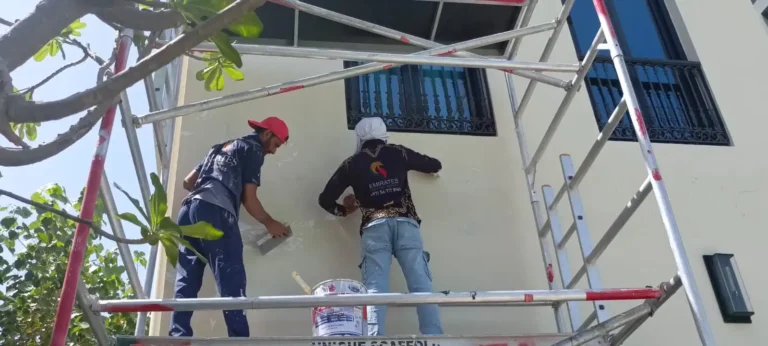
Even the best exterior paint will fail prematurely if the surface it is applied to is not correctly prepared. This is particularly important in Dubai, where the existing exterior surfaces of older villas often show chalking, cracking, loose paint, or moisture damage from previous seasons.
Correct surface preparation for exterior painting in Dubai includes:
- Washing down the entire facade to remove dust, chalking, and surface contamination
- Removing all loose, flaking, or poorly adhered existing paint
- Filling cracks and repairing surface damage with appropriate filler or render
- Treating any areas showing biological growth (algae, mould) with an appropriate biocide before painting
- Applying the correct primer or sealer for the substrate and chosen topcoat system
- Allowing full cure time before applying topcoats
Skipping or rushing any of these steps — even with an excellent quality topcoat — will result in adhesion failure, blistering, or early peeling. Preparation is where the performance of an exterior paint system is truly determined.
Common Mistakes That Cause Premature Paint Failure in Dubai
Using interior paint on exterior surfaces
The most common cause of early failure. Interior emulsion is not formulated for UV, heat, or moisture exposure outdoors. Always use exterior-grade coatings outside.
Painting over chalked or dusty surfaces without cleaning
Paint applied over chalked, dusty, or contaminated surfaces will not bond properly — and will peel within months. The surface must be washed and decontaminated first.
Skipping primer on repaired areas
Filled or patched areas absorb topcoat unevenly if not primed — leaving visible patches and compromising adhesion at those points.
Painting in extreme heat or direct sun
Applying paint to surfaces that are extremely hot (above around 40°C) causes the paint to dry too quickly — reducing adhesion and film quality. Painting should be timed to avoid the hottest part of the day.
Applying topcoat before the surface is fully dry
In Dubai’s humid conditions, moisture trapped beneath paint films causes blistering. Adequate drying time must be observed — particularly after washing the surface or applying filler.
Choosing a contractor based only on price
Lower-priced quotations often exclude correct preparation, use cheaper materials, or apply too few coats. The result is a paint job that fails early — costing more overall than a correctly specified job done once.
What to Ask Your Painting Contractor Before Agreeing to an Exterior Repaint
- What exterior paint product are you using — brand, product name, and finish grade?
- Is this product specifically rated for high-UV, high-temperature climates?
- How many coats will be applied — including primer?
- What surface preparation will be done before painting begins?
- How will chalked or damaged areas be treated?
- What time of day will exterior painting take place — to avoid peak heat?
- Is the quotation fixed — or can material costs be added later?
Emirates Painting Services: Exterior Painting for Dubai’s Climate
Emirates Painting Services provides exterior painting services for villas, apartments, and commercial properties across Dubai — using paint systems and preparation methods that are appropriate for the UAE’s climate, not simply the cheapest available option.
- Exterior-grade, climate-appropriate paint systems — not interior paint used outside
- Thorough surface preparation — washing, filling, priming, and treating biological growth before any topcoat
- Work timed to avoid peak heat for optimal application conditions
- Free on-site assessment of the existing exterior surface condition
- Clear, written quotation specifying the paint product, preparation scope, and number of coats
- Service across all Dubai villa communities, apartments, and commercial buildings
Ready to Repaint Your Villa Exterior?
Get a free assessment and written quote from Emirates Painting Services — using the right paint for Dubai’s conditions.
Request a Free Exterior Quote
View Exterior Painting Services