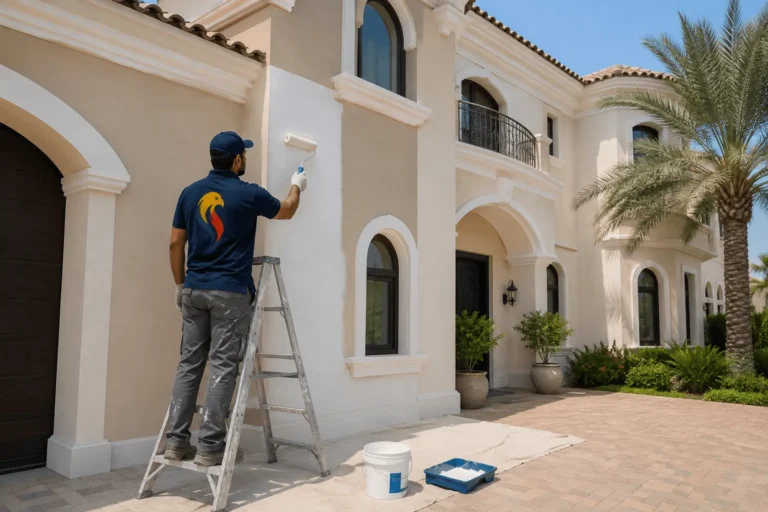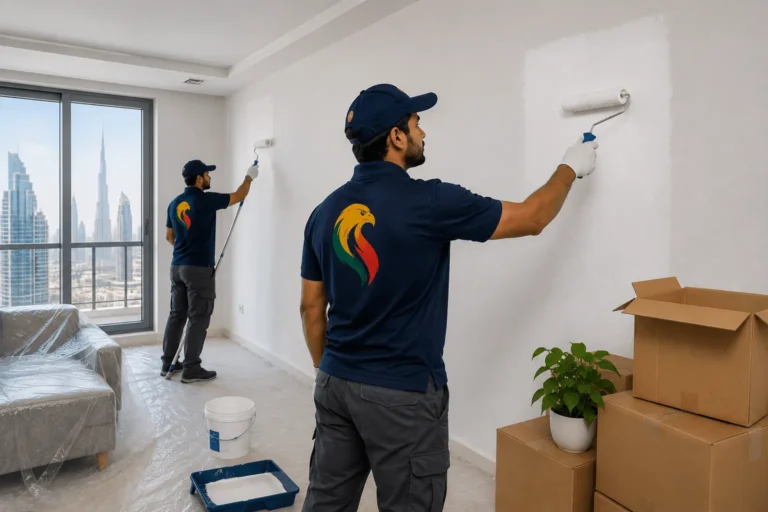
Apartment Handover Painting in Dubai: What Tenants and Landlords Each Owe
| Moving Out of a Dubai Apartment? A Fresh Coat of Paint Isn’t Automatically Your Responsibility. |
Whether the tenant or the landlord should arrange and pay for repainting depends on the tenancy agreement, documented move-in condition, cause of the damage and whether the deterioration is ordinary wear and tear. The right approach is to determine responsibility first, then decide what actually needs painting.
This guide is intended to help tenants and landlords in Dubai assess their position before moving ahead with any painting work. It does not constitute legal advice. For specific disputes, consult a qualified UAE legal professional or contact Dubai Land Department.
Who Pays for Apartment Painting at Handover in Dubai?
There is no single rule. Each handover situation depends on the specific circumstances. The table below is a practical starting point for assessment — not a legal determination.
| Situation | Responsibility to Assess |
| Minor fading from ordinary use | Generally ordinary wear and tear |
| Normal ageing of existing paint | Generally landlord maintenance |
| Tenant-painted feature wall | Tenant restoration obligations may apply |
| Large holes or avoidable wall damage | Potential tenant responsibility |
| Existing damage documented at move-in | Not automatically the outgoing tenant’s responsibility |
| Peeling caused by an unresolved building leak | Investigate cause and maintenance responsibility |
| Lease explicitly requires repainting | Review the clause and its legal effect |
| Landlord wants a different colour for the next tenant | Not automatically an outgoing tenant expense |
| Important: This matrix is a practical assessment guide only. Responsibility in any specific case depends on the tenancy agreement, documented evidence and applicable law. |
What Does Dubai Tenancy Law Actually Say About Painting?
Dubai Law No. 26 of 2007 provides the core framework. The relevant articles are summarised below. For the full text, refer to the official Dubai tenancy law.
Article 21 — Returning the Apartment in Its Original Condition
Article 21 requires the tenant to return the property in its original condition at the end of the tenancy — except for ordinary wear and tear, or damage that occurs outside the tenant’s control. This means a tenant is not automatically required to repaint walls that have aged normally during a legitimate occupancy.
Article 19 — Tenant Maintenance and Alterations
Article 19 requires the tenant to maintain the property appropriately and to follow the terms agreed for any alterations and restorations. If a tenant painted walls in a colour not approved by the landlord, or made other unauthorised changes, Article 19 and the tenancy agreement terms become relevant to any restoration obligation.
Articles 16 and 17 — Landlord Maintenance Responsibilities
Article 16 places general responsibility for maintenance and repairs affecting the property’s intended use with the landlord, unless otherwise agreed. Peeling caused by a building leak, structural crack or underlying defect is not automatically the tenant’s responsibility to repair — the root cause must be assessed first.
Article 20 — Security Deposits
Article 20 requires the landlord to refund the security deposit, or its remaining balance, at tenancy expiry. A deduction for painting costs requires a clear basis: actual obligation, documented damage and an itemised quotation. The simple preference for a freshly painted apartment does not establish an automatic right to deduct.
Normal Wear and Tear vs Tenant-Caused Wall Damage
This is the most important practical question at any apartment handover. The distinction between ordinary wear and actual damage determines who may be responsible for painting costs.
| Wall Condition | What to Check |
| Light scuffing | Severity and whether consistent with ordinary use |
| Minor fading | Age of the tenancy and sunlight exposure |
| Nail or screw holes | Size, number and whether permission was granted |
| Large TV-mount holes | Extent of restoration needed |
| Dark feature walls | Original approved colour and written landlord consent |
| Peeling or bubbling | Moisture source, preparation history or physical impact |
| Water stains | Cause of water ingress and maintenance responsibility |
| Crayon or heavy staining | Whether cleaning resolves the problem or repainting is required |
| Key point: Not every mark is tenant damage, and not every damaged wall needs a full repaint. Assess the cause before agreeing to any painting scope. |
When Should Tenants Arrange Repainting Before Moving Out?
Tenants in Dubai may appropriately arrange repainting in four situations:
1. Colour changes requiring restoration. If the tenant painted walls in an unapproved colour or feature finish, restoring the original appearance may be an agreed obligation. Confirm the exact original colour and finish specification with the landlord in writing before booking painters.
2. Wall damage beyond ordinary wear. Deep gouges, significant impact damage or extensive staining that goes beyond everyday use may require remedial painting. The scope should match the actual damage rather than defaulting to a full apartment repaint.
3. Agreed obligations in the tenancy. Some tenancy agreements include an explicit repainting clause. Review the exact wording. Not every clause that mentions ‘good condition’ automatically requires a fresh coat of paint at move-out.
4. Painting agreed as part of handover resolution. Where both parties have agreed that certain painting work is part of an amicable handover, confirm the scope, colour, finish and contractor approval in writing before proceeding.
For tenants arranging Move-Out Painting Services in Dubai, Emirates Painting Services can assess the wall condition and confirm the appropriate scope before any painting begins.
When Is Repainting the Landlord’s Responsibility?
Landlords carry maintenance and repainting responsibility in several common situations:
Ageing consistent with ordinary use. Paint that has faded, lost sheen or shows normal surface wear over a multi-year tenancy is generally the landlord’s maintenance responsibility, not the tenant’s.
Repainting for the next tenant’s preference. Choosing a new colour scheme for an incoming tenant is not an outgoing tenant expense unless the outgoing tenant caused specific damage requiring restoration.
Underlying leaks and building defects. Peeling or staining caused by a structural issue, plumbing fault or unresolved building defect is a landlord maintenance matter. Repainting without resolving the cause will not prevent recurrence.
If you’re a landlord considering repainting as part of a wider property refresh, the Should You Paint Your Dubai Property? guide covers the investment case in detail.
Does a Tenant Have to Repaint the Entire Apartment?
Short answer: not automatically.
The appropriate response depends on what has actually occurred. The options, in order of increasing scope, are:
— Cleaning washable marks (no painting required)
— Filling isolated holes (no painting required)
— Touching up specific areas
— Repainting a damaged or altered wall
— Repainting a room
— Repainting the entire apartment
One practical note on touch-ups: where the existing paint has aged or the colour and sheen no longer match, isolated touch-ups may remain visible. In such cases, repainting a complete wall produces a cleaner, more consistent result — but this is a practical consideration, not an automatic obligation.
Can a Landlord Deduct Painting Costs From the Security Deposit?
A deduction from the security deposit for painting costs requires a clear and documented basis. The following factors are relevant to any assessment:
The tenancy agreement. Does it include a specific, enforceable repainting obligation? General clauses about ‘good condition’ or ‘fair condition’ do not automatically require full repainting.
Move-in and move-out documentation. Photographs taken at both the start and end of the tenancy provide the most objective record of wall condition. Without move-in documentation, establishing that specific damage is the tenant’s responsibility is more difficult.
The nature of the damage. A deduction requires evidence of actual damage beyond ordinary wear and tear. A landlord’s preference for freshly painted walls does not establish that obligation.
An itemised painting quotation. Any deduction should be supported by a specific, itemised cost for the actual work required — not a blanket apartment repainting charge applied without assessment.
| Important: A painting invoice establishes the cost of work — not, by itself, which party is legally responsible for paying it. |
For disputes regarding security deposit deductions, the appropriate channel is the Rental Dispute Centre operated by Dubai Land Department. Emirates Painting Services is a painting contractor — we assess wall condition and carry out painting work. We cannot and do not determine legal liability between parties.
Apartment Handover Painting Checklist for Tenants and Landlords
Use this checklist before any handover painting begins:
☐ Review the tenancy agreement and any painting clauses
☐ Compare current wall condition with documented move-in photographs
☐ List all marks, holes, stains and peeling areas
☐ Identify what is ordinary wear and what may be actual damage
☐ Agree in writing on the areas and scope of work required
☐ Confirm the original or approved paint colour and finish
☐ Check building access requirements and contractor approvals
☐ Obtain an itemised painting quotation covering only the agreed scope
☐ Take dated photographs of completed work before handover
How Much Does Apartment Handover Painting Cost in Dubai?
Painting costs vary based on the specific apartment and scope of work required. The factors that affect any quotation are:
| Factor | Why It Affects Cost |
| Apartment size | Total paintable wall and ceiling surface |
| Existing condition | Cleaning, sanding and minor repairs before painting |
| Scope | Touch-up, selected walls, room or full apartment |
| Paint colour | Matching an existing colour or specifying a new one |
| Paint finish | Product grade and application requirements |
| Building access | Contractor permissions and working hours |
| Completion deadline | Scheduling to fit the handover timeline |
For Apartment Painting Services in Dubai, Emirates Painting Services provides an itemised quotation based on the actual apartment and the agreed scope. Prices are subject to a physical assessment.
How Emirates Painting Services Helps With Apartment Handover
Emirates Painting Services begins with an assessment of the apartment’s actual wall condition before agreeing any scope or price. Our role is to carry out painting work correctly — we do not determine legal liability between tenants and landlords.
| Step | What Happens |
| 1 — Assess | Review wall and ceiling condition, existing paint and any damage |
| 2 — Confirm Scope | Identify repairs, selected walls or full apartment repainting required |
| 3 — Match the Finish | Confirm original colour, paint product and sheen level |
| 4 — Prepare and Paint | Protect surfaces, carry out repairs and apply the agreed coating |
| 5 — Inspect and Document | Walk-through inspection and relevant work records provided |
See the Home Painting Services page for a full overview of Emirates Painting Services residential work across Dubai.
FAQs About Apartment Handover Painting in Dubai
1. Is repainting mandatory when moving out of a Dubai apartment?
Not automatically. Article 21 of Dubai’s tenancy law requires tenants to return the property in its original condition, except for ordinary wear and tear. Minor fading and light scuffing from everyday use are generally not grounds for a mandatory repaint.
2. Who pays for painting between tenants in Dubai?
This depends on the condition of the apartment and the terms of the tenancy agreement. Repainting required by tenant damage is typically the tenant’s cost. Repainting to refresh the apartment for a new tenant, or to address ageing paint, is generally the landlord’s cost.
3. Can a landlord charge for ordinary wall wear and tear?
Article 21 of Dubai’s tenancy law specifically excludes ordinary wear and tear from the tenant’s restoration obligations. A landlord cannot automatically deduct for wall scuffing, minor fading or small marks consistent with normal occupancy. Evidence of actual damage is required.
4. Do tenants need to repaint walls after removing TV mounts?
Not necessarily a full wall repaint. Small holes from standard fixings may be filled rather than repainted. Larger damage — wide anchor holes, cracked render or removed cable runs — may require remedial work. The appropriate scope depends on the actual condition after removal.
5. Can a landlord deduct full apartment painting from the security deposit?
Not without justification. A deduction must correspond to actual, documented damage and a specific, itemised quotation. Applying a full apartment repainting cost without a condition-based assessment is not automatically a valid deposit deduction under Dubai tenancy law.
6. Should tenants repaint without written landlord approval?
No. Before carrying out any repainting, tenants should obtain written agreement from the landlord on the required colour, finish and contractor. Proceeding without agreement can lead to disputes about whether the restoration meets the required standard.
7. Can I book painting for only the damaged walls?
Yes. Emirates Painting Services can assess and repaint selected walls or rooms rather than an entire apartment. Where the existing paint has aged, a full wall repaint may give a better visual result than isolated touch-ups — but the scope is agreed with you based on the actual condition.
| Need Apartment Painting Before Handover?Whether you’re a tenant preparing for an inspection or a landlord getting an apartment ready for its next occupant, Emirates Painting Services can assess the wall condition and recommend a suitable painting scope.📋 Get an Apartment Handover Painting Quote → Request a Quote💬 Send Apartment Photos on WhatsApp → WhatsApp Us📞 +971 567 178 165 |