How Dubai’s Climate Destroys Paint — And What to Use Instead
Your paint may be failing because of what it faces every day — not simply because it is old. A façade in direct sunlight, a shaded boundary wall and a bathroom interior all encounter different conditions. Treating them as the same painting problem produces the same outcome: early failure.
Understanding how Dubai’s environment stresses a coating system helps you ask the right questions before the next repaint — and choose a specification suited to the actual exposure rather than the nearest product on a shelf.
What Dubai’s Climate Actually Does to Paint
The table below outlines the primary climate factors, their effects on paint, and what each condition requires you to consider before specifying a coating system.
| Climate Factor | Possible Paint Damage | What to Consider |
|---|---|---|
| Strong UV exposure | Fading, chalking | UV and colour-retention performance of the coating |
| Heat and thermal movement | Cracking, adhesion stress | Suitable flexible exterior coating system |
| Humidity and condensation | Blistering, mould-related issues | Moisture diagnosis before specifying a coating |
| Sand and dust | Surface contamination, abrasion | Cleaning protocol and appropriate exterior finish |
| Coastal salt exposure | Coating deterioration, metal corrosion | Substrate-specific protective coating system |
| Hot surface at painting | Poor film formation, early failure | Apply only within manufacturer temperature limits |
One important point: the same climate does not damage every surface identically. A south-facing exterior wall receives far more solar radiation than a shaded north elevation. A bathroom wall traps moisture an exterior façade does not. Surface type, orientation and ventilation all determine what your paint actually faces — and what it needs to withstand.
Six Warning Signs Your Paint Is Failing
Each symptom has a different cause. Identifying which type of failure you have before repainting determines whether preparation alone resolves the problem, or whether investigation is needed first.

Sun-facing exterior surfaces lose colour intensity over time. Uneven fading often indicates inconsistent application or product quality. Confirm what was used before assuming the problem is cosmetic.
A chalky residue indicates binder degradation. Repainting directly over chalk transfers the adhesion problem to the new coat. Consolidation or removal is required first. See the peeling paint guide.
Peeling indicates adhesion failure between the coating and the substrate. Causes include moisture beneath the film and incompatible layers. Identify the cause before specifying a repair.
Blisters form when moisture becomes trapped beneath the paint film, or when paint is applied outside the manufacturer’s conditions. Resolve the moisture source before repainting.
Fine surface cracks in the coating differ from structural cracking in the masonry. Deep cracks that recur after repainting require a building assessment before any painting work begins.
Mould is a moisture and ventilation problem, not a paint problem. A fresh coat without resolving the cause will not prevent recurrence. Identify the source first.
Why Villa Exteriors Need a Different Paint System

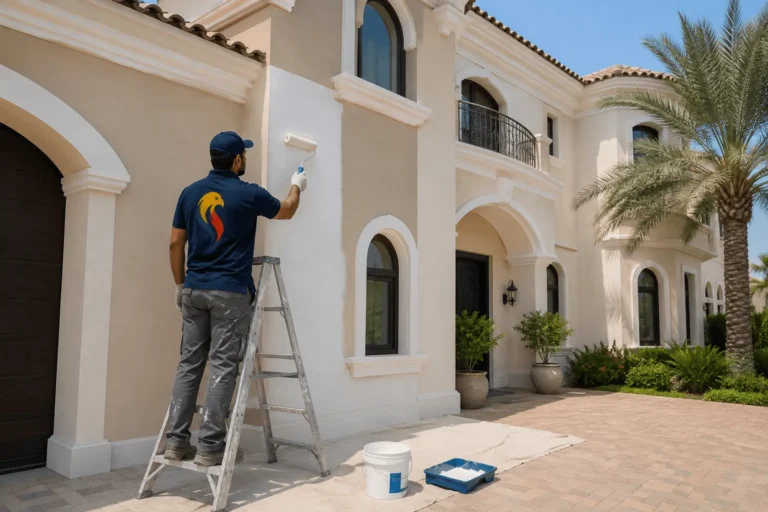
A Dubai villa exterior involves multiple exposure types within a single property. A sun-facing rendered façade, a shaded and often damp north elevation, a boundary wall, metal gates and timber elements each require different assessment and coating specification.
Applying a single exterior product to every surface without checking substrate condition, orientation, existing coatings and moisture behaviour is a common cause of uneven results and early coating failure.
The appropriate response is a surface-by-surface assessment — not a single specification for the entire property. See the Exterior Painting Services in Dubai guide for the approach by surface type.
What Paint Should You Use Instead?
The table below matches common surface and condition types to the coating category worth investigating. Verify product suitability against the manufacturer’s technical data sheet and actual substrate conditions before specifying.
| Surface / Situation | Coating Type to Investigate |
|---|---|
| Sound exterior render | Quality exterior acrylic masonry coating |
| Hairline cracking on suitable masonry | Compatible crack-bridging or elastomeric system |
| Exterior requiring water repellency | Silicone-modified or other suitable exterior masonry system |
| Busy interior walls | Washable interior wall coating |
| Bathroom or humid room | Interior product specified for moisture conditions |
| Exterior metal gates | Corrosion-control primer and compatible metal topcoat |
| Exterior timber | Appropriate flexible exterior wood coating |
Important: an elastomeric coating is not automatically the right solution for a damp or structurally unstable wall. The complete system — primer, preparation and topcoat — must be compatible with the wall’s substrate and moisture behaviour. For further detail on exterior coating properties, refer to the best exterior paint for Dubai heat guide.
Why Premium Paint Can Still Fail in Dubai
Choosing an expensive product does not guarantee the finish. Five preparation and application factors consistently cause early failure regardless of product quality.
Painting over loose, chalky or contaminated surfaces. The topcoat bonds to the contamination layer, not to the wall itself.
Applying paint to damp masonry. Trapped moisture causes blistering and adhesion failure after application.
Using an incompatible primer or coating combination. Not every product is suitable for every substrate or previous coating system.
Painting when wall surface temperature exceeds the product’s application limits. Midday summer surfaces in Dubai can reach conditions outside manufacturer guidance.
Applying insufficient coats or incorrect film thickness. Minimum film thickness requirements exist for durability — not appearance alone.
Key takeaway: a premium topcoat applied to a poorly prepared surface will fail sooner than a standard product applied correctly. Preparation is the foundation of every lasting result.
Does Paint Colour Affect Heat Damage?
Lighter surfaces typically reflect more solar radiation, resulting in lower surface temperatures. This reduces thermal cycling stress on both the coating and the substrate — especially relevant for smooth render finishes.
Darker surfaces absorb more solar radiation and reach higher surface temperatures. This requires careful attention to the coating system, application conditions and colour specification relative to the product’s performance range.
Some exterior products incorporate solar-reflective pigments. Benefits vary by product, colour and application quality. They do not guarantee a fixed reduction in indoor temperature — that depends on the building’s insulation and ventilation too.
When Is the Right Time to Paint in Dubai?
Surface temperature matters more than air temperature alone. Walls exposed to direct afternoon sun in Dubai can reach conditions that exceed manufacturer application limits for much of the year between late spring and early autumn.
Humidity rises significantly during summer, affecting both film formation and drying intervals between coats. Both surface temperature and ambient humidity must fall within the product’s specified range at the time of application.
For month-by-month detail on application conditions across Dubai, refer to the best time of year to paint in Dubai guide rather than relying on seasonal assumptions alone.
How to Prevent Paint Damage Before It Starts
Preventing failure follows a clear professional sequence. Every stage supports the next — skipping any step to save time produces a result that requires attention sooner.
Assess existing coating adhesion, moisture content, surface condition and any structural issues before selecting a coating system.
Address cracks, hollow render, efflorescence and moisture problems before painting begins.
Clean, sand or strip as required. Apply a primer or sealer compatible with the substrate and the chosen topcoat.
Select a coating system based on surface type, orientation, existing coatings and verified manufacturer data.
Follow application temperature, humidity and film thickness requirements on the day of painting.
Final check of coverage, edges and surfaces specified in the agreed scope before handover.
How to Choose a Paint That Lasts in Dubai
Before accepting a quotation for exterior or interior repainting, request the following in writing. A painter who cannot provide this information cannot verify the specification at handover.
For a more detailed look at coating properties and surface-specific selection, refer to the best paint for Dubai’s climate guide, which covers both interior and exterior options in depth.
When Should You Repair, Repaint or Investigate Further?
Not every paint problem requires a full repaint. The appropriate response depends on what is causing the failure.
| Condition | Recommended Next Step |
|---|---|
| Mild fading, coating sound | Assess whether cosmetic repainting is needed now |
| Chalky or powdery surface | Check coating stability and preparation requirements |
| Localised peeling | Identify the cause before repairing the affected area |
| Widespread coating failure | Assess removal and full repainting |
| Recurring damp or blistering | Investigate the moisture source before painting |
| Deep or recurring cracks | Obtain a building assessment before painting |
How Emirates Painting Services Approaches Climate-Exposed Walls

Emirates Painting Services begins with a surface assessment before agreeing a scope or price. Identifying the paint failure — fading, peeling, blistering, cracking, moisture — determines the appropriate preparation, repair and coating specification.
Inspect adhesion, moisture content and existing coating condition
Address cracks, hollow render, moisture and incompatible layers
Select primer and topcoat matched to the actual substrate and exposure
Walk-through against the agreed scope before handover
See the exterior painting services and villa painting services pages for how this applies to specific property types.
Frequently Asked Questions
Common questions about paint failure and coating selection for Dubai properties — answered directly.
Exterior surfaces in Dubai face UV index values consistently above 10 for much of the year. Pigment stability and binder quality determine how a coating holds colour over time. Lower-specification products or insufficient coats degrade more visibly, especially on south-facing elevations.
There is no single answer. Exterior masonry coatings with documented UV and thermal resistance are appropriate for rendered walls. Metal and timber require substrate-specific systems. Specification should be based on the actual surface and conditions, not product descriptions alone.
For surfaces exposed to direct sun, UV resistance is a relevant property to confirm. Ask for the product’s technical data sheet and check UV stability, colour retention and film integrity ratings against the manufacturer’s published guidance for your climate zone.
Yes. High ambient humidity during application affects film formation. Moisture within the substrate — from condensation, rising damp or inadequate sealing — causes blistering and adhesion failure after application. Both are common problems in Dubai’s coastal and summer-humidity conditions.
No. Elastomeric coatings are designed for masonry with hairline cracking or movement. They are not appropriate over damp substrates, incompatible primers or coatings with existing adhesion problems. The system must be matched to the actual surface condition.
Some heat-reflective products reduce surface temperature, which may lower heat transfer through the wall. The extent of any indoor temperature benefit depends on the building’s insulation, ventilation and construction — not the coating alone. Claims of specific temperature reductions should be supported by manufacturer documentation.
If the existing coating is sound, clean and compatible with the new system, overcoating may be appropriate. If it is chalky, peeling, blistering or of unknown composition, it requires assessment or removal before repainting. Applying fresh paint over a failing coating transfers the failure to the new layer.
Fading, peeling, chalking and cracks do not all require the same repair.
Emirates Painting Services can assess your property’s surface condition and recommend
appropriate preparation and painting work.