Signs Your Villa Exterior Needs Repainting
Home › Blog › Signs Your Villa Exterior Needs Repainting
Signs Your Villa Exterior Needs Repainting:
A Complete Dubai Homeowner Checklist
Most Dubai villa owners treat exterior paint as a cosmetic concern — something to consider when the colour looks a little tired. In reality, a villa’s exterior coating is the primary barrier between your walls and one of the most demanding outdoor environments on earth. This guide helps you know exactly when to act — and what to fix first.
Quick answer: Peeling paint, faded colours, chalky walls, visible cracks, bubbling, stains and exposed surfaces are some of the clearest signs that a villa exterior may need repainting in Dubai. If you notice several of these together, a professional exterior inspection is the recommended next step.
- Quick Yes/No Checklist
- 10 Clear Signs Your Villa Needs Repainting
- Why Paint Deteriorates Faster in Dubai
- Repaint, Repair or Just Clean?
- How Often to Repaint in Dubai
- Do Not Repaint Until These Are Fixed
- What Happens During an Inspection?
- Best Time to Repaint
- DIY vs Professional Painters
- Why Choose Emirates Painting Services
- Pre-Booking Checklist
- Frequently Asked Questions
Dubai’s climate is genuinely punishing on exterior surfaces. Ultraviolet radiation is intense year-round, surface temperatures on sun-facing walls can exceed 70°C in summer, humidity creates conditions for moisture penetration in certain seasons, and dust and sand continuously abrade the surface. Coastal locations add salt-laden air into the equation. Under these conditions, even a quality exterior coating applied professionally will eventually begin to degrade.
The challenge is recognising when that degradation has moved beyond normal weathering into territory where the coating is no longer protecting your walls. Fading may look cosmetic. Chalking might go unnoticed. Hairline cracks might seem minor. But each is a signal — and addressed early, they cost far less to correct than if left until the underlying render or substrate is involved.
This guide gives you a practical checklist of the visible signs that a villa exterior may need repainting, along with guidance on when to repair first, how often to expect repainting in Dubai’s climate, and what a professional exterior inspection covers.
Walk around all four sides of your villa in daylight and note which of the following you can see. A single issue may not demand immediate action — several together usually do.
- Exterior colour looks faded or noticeably uneven between walls
- Paint is peeling, flaking or lifting away from the surface
- Rubbing your hand on the wall leaves a chalky powder residue
- Hairline cracks have appeared in the paint film or render
- Sections of paint are bubbling or blistering
- Dark stains, damp patches or discolouration are visible
- Previous repair patches are showing through
- Walls look dirty or stained even after cleaning
- Metal gates, railings or exterior metalwork show rust
- Caulking or sealant around windows and doors is cracked or missing
- Bare render, concrete or masonry is becoming visible
- Your villa looks noticeably older than surrounding properties
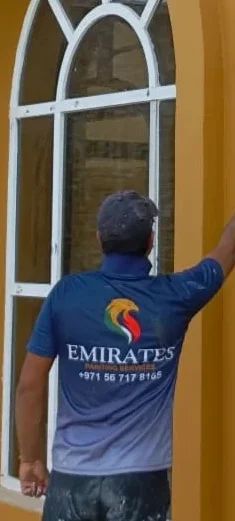
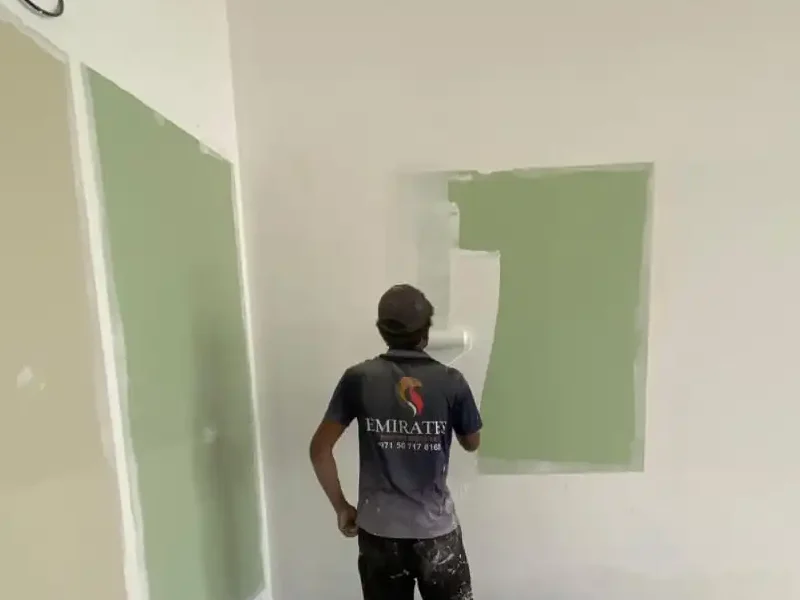
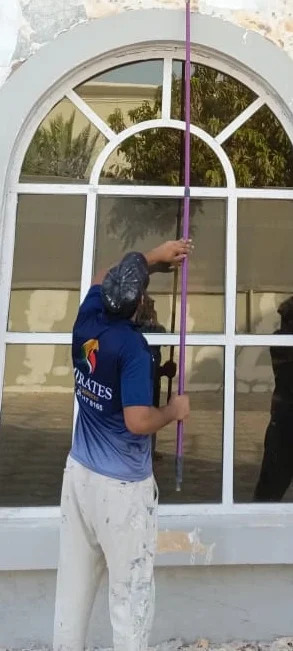
These are the ten most common and diagnostic indicators that an exterior repaint may be due. Some are straightforward cosmetic signals. Others point to coating failure or an underlying problem that needs addressing before paint is applied.
Exterior Paint Has Started Fading
Colour fading is the most visible form of UV degradation. Ultraviolet radiation breaks down the pigment and binder in exterior coatings over time — no paint is immune, though higher-quality products with UV-stable pigments resist it considerably longer.
In Dubai, fading is accelerated by the fact that direct sunlight is intense year-round and walls can receive ten or more hours of uninterrupted sun exposure on south and west-facing elevations. The result is often uneven: a north-facing wall may still look close to its original colour while the south facade looks washed out.
What to look for: an overall dull or bleached appearance, colours that no longer match between shaded and sunlit walls, and a general loss of depth. A faded exterior is not merely cosmetic — it signals that the coating’s protective capacity has also diminished.
Related: Exterior Painting Services Dubai — surface preparation, primer and weather-resistant coating systems.
Paint Is Peeling, Flaking or Cracking
Peeling and flaking is more serious than fading because it represents a complete loss of adhesion between the coating and the substrate beneath it. Once a coating begins to peel, moisture and contaminants can reach the render or masonry directly, and the failure area tends to expand.
Common causes include poor surface preparation before the previous paint was applied, a coating that has reached the end of its usable life, moisture trapped beneath the film, or the wrong product applied to the wrong surface.
Peeling paint cannot simply be painted over. Loose and failed coating must be fully removed, the surface prepared, any underlying damage repaired, and a compatible primer applied before the finish coat.
Your Exterior Walls Feel Chalky
Chalking is the process by which the binder in an exterior coating breaks down under UV exposure, leaving behind a loose powdery residue of pigment on the surface. It is one of the more common signs of coating degradation in Dubai and one of the easiest to test for.
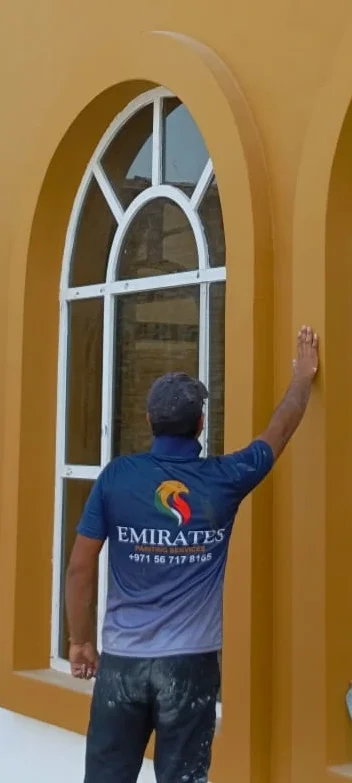
The chalking test: in daylight, gently rub a clean palm over the wall surface. A powdery residue that transfers easily indicates chalking. Heavy chalking — where a visible powder transfers with minimal pressure — suggests the coating has degraded to the point where it provides limited protection.
Chalked surfaces require cleaning and surface preparation before repainting. Applying a new finish coat directly over heavy chalking produces poor adhesion — the new paint bonds to the loose residue rather than the wall.
Hairline Cracks Are Appearing on the Facade
Cracking on exterior walls takes several forms, and they are not all equivalent.
Paint-film cracking — fine, shallow crazing patterns confined to the paint surface — indicate the coating has become brittle and lost flexibility. This is a coating-life issue resolved through removal, preparation and repainting.
Render or plaster cracks — extending into the render beneath — may result from thermal movement, minor settlement, or mechanical impact. They need to be assessed, filled and allowed to cure before repainting.
Structural or recurring cracks — wide, irregular, full-thickness, or returning after filling — require investigation by a structural specialist before any surface work.
Paint Is Bubbling or Blistering
Bubbling and blistering typically indicates that moisture or vapour is trapped beneath the coating, causing it to detach from the wall in localised areas. The blister may be filled with water or air — in either case the bond between paint and substrate has been broken.
Common causes in Dubai villas include painting over a damp surface, irrigation striking the wall base, water ingress from parapet walls, failed caulking around windows, or residual moisture from a previous leak that was not fully resolved before repainting.
Blistering must be investigated rather than simply repainted. The moisture source must be identified and corrected — otherwise the new coating will fail in the same location.
Dark Stains, Damp Patches or Mould Keep Returning
Persistent staining and damp patches on exterior walls are one of the most important signals to take seriously, because paint alone cannot fix them. If a wall is stained by moisture from an active source, repainting produces a temporary cosmetic improvement followed by the same staining returning through the new coat.
Common sources in Dubai villas include failed parapet or roof waterproofing, cracks in the facade allowing water ingress during rain, irrigation sprinkler coverage reaching the wall base, and drainage problems directing water toward the wall.
In shaded or permanently moist areas, algae and mould growth is possible. These surface contaminants must be treated and removed before repainting — a biocide wash and appropriate dwell time are needed before surface preparation proceeds.
Bare Render, Concrete or Masonry Is Becoming Visible
When the paint film has failed to the point that the underlying substrate — render, concrete block, masonry or plaster — is exposed, the surface has lost its protective coating entirely in those areas. The substrate is now directly exposed to UV radiation, moisture, dust and temperature cycling.
Bare render on an exterior facade requires prompt attention. The exposed area should be assessed, damaged render repaired and allowed to cure, the surface cleaned, a compatible primer applied and the finish coat matched to the surrounding wall.
Related: Villa Painting Services Dubai — surface repair, primer and full exterior villa repainting.
Walls Look Old Even After Pressure Washing or Cleaning
One of the most useful diagnostic questions: after the wall has been cleaned, does it look genuinely better — or does it still look faded, patchy and worn?
Surface dirt and grime can often be removed by professional pressure washing, leaving the underlying coating looking close to its original condition. If that is the result, repainting may not yet be necessary — cleaning was the appropriate action.
However, if a wall still looks discoloured, faded or visibly weathered after thorough cleaning, the issue is not surface contamination — it is the coating itself. Permanent discolouration and deep fading do not wash off, and this distinction helps homeowners avoid both unnecessary repainting and unnecessary delays when repainting is genuinely due.
Gates, Railings and Exterior Metalwork Are Rusting
Exterior metalwork — entrance gates, boundary railings, metal window frames, balcony balustrades, pergola frames — is subject to corrosion in Dubai’s environment, particularly in humid or coastal locations.
Visible rust indicates that the protective coating has failed and the underlying metal has begun oxidising. If left unaddressed, rust spreads beneath the remaining coating, and surface rust can advance to structural corrosion in thinner metal sections.
The correct process is not simply to paint over rust. It must be mechanically removed to a clean metal surface — by wire brushing, grinding or blasting depending on severity — any active corrosion treated with a rust converter, and a rust-inhibiting primer applied before the finish coat.
Your Villa Has Lost Its Curb Appeal
Not every indicator of a needed repaint is structural. The overall visual impression of a villa matters — for the satisfaction of living in it, for its position in the neighbourhood and, practically, for its rental and resale value.
A villa with a patchy facade, stained boundary walls, rust-streaked gates and a faded colour scheme can appear significantly older and less well-maintained than it actually is. In managed communities where surrounding properties are repainted on a regular schedule, a villa that has gone too long between repaints stands out for the wrong reasons.
If you are planning to rent or sell the property, a colour refresh and full repaint delivers a far more substantial improvement in kerb appeal than cleaning alone.
Not sure where your villa stands?A free site inspection gives you a clear, written assessment — no commitment required.
Understanding why exterior paint degrades faster in Dubai than in many other climates helps homeowners set realistic expectations about repainting frequency — and why the choice of paint system and quality of application matter considerably more here than in milder environments.
Intense UV and Sun Exposure
Dubai receives around 3,500 hours of sunshine per year. The UV index regularly reaches 11 or higher in summer — classified as extreme. Extended UV exposure is the primary driver of colour fading, binder degradation, chalking and coating embrittlement. South and west-facing walls typically deteriorate noticeably faster than north and east-facing elevations on the same villa.
High Surface Temperatures
Air temperatures in Dubai peak at around 45°C to 50°C in summer, but wall surface temperatures on sun-facing facades can reach 70°C or above. The repeated daily cycle of heating and cooling causes exterior walls and their coatings to expand and contract continuously. Over years, this thermal cycling stresses the paint film, contributing to cracking, loss of adhesion and detachment.
Humidity and Moisture
While Dubai is predominantly dry, humidity levels rise significantly between September and November and during the Khareef period. Moisture penetration into a degraded or cracked coating accelerates failure, and the combination of high temperatures and periodic humidity worsens existing defects faster. Shaded walls facing prevailing winds during humid periods are particularly susceptible.
Dust, Sand and Airborne Contaminants
Dubai’s frequent dust events and seasonal shamal winds deposit fine sand and mineral particles on exterior surfaces throughout the year. These act as a mild abrasive that gradually wears exterior coatings, and the accumulation of dust on rough or chalked surfaces accelerates visible deterioration.
Coastal Salt Exposure
For villas in waterfront communities — Palm Jumeirah, Dubai Marina, Jumeirah Beach Road — salt-laden air is an additional factor. Sodium chloride deposited on exterior surfaces accelerates corrosion of metalwork, penetrates paint film defects and contributes to efflorescence on masonry.
Related: Villa Painting Palm Jumeirah — specialist villa painting with salt-resistant systems for coastal communities.
Not every deteriorating villa exterior needs a complete repaint — and not every problem can be solved by cleaning. This table gives a practical starting point for deciding which action is appropriate.
| What You See | Likely Action Required |
|---|---|
| Surface dust, dirt or grime only | Professional cleaning may be sufficient — inspect coating after |
| Mild fading, otherwise intact | Monitor; plan repaint when fading is significant |
| Heavy fading across all elevations | Repaint — UV degradation is advanced |
| Chalky residue when rubbed | Surface preparation, priming and repainting |
| Peeling or flaking paint | Remove failed coating, prepare surface, repair, repaint |
| Hairline paint-film cracks | Inspect, then prepare and repaint with flexible exterior system |
| Render or plaster cracks | Fill, cure and repaint — or investigate cause if recurring |
| Major or deep cracks | Structural assessment before any surface work |
| Persistent damp patches or staining | Identify and fix moisture source before repainting |
| Bubbling or blistering | Diagnose moisture or adhesion cause — cannot be painted over |
| Rusting metalwork | Rust removal, treatment, primer and repaint |
| Bare render or exposed masonry | Repair, cure, prime and repaint |
| Algae or mould growth | Biocide treatment, wash, cure, then repaint |
A single universal number does not serve Dubai villa owners well, because repainting frequency depends on factors that vary significantly between properties. A commonly cited general guideline for well-executed exterior repainting using a quality paint system in Dubai’s climate is five to seven years — but this is a starting point, not a firm rule.
Properties on the shorter end of this range typically have:
- South or west-facing facades with prolonged direct sun exposure
- Coastal location with salt-laden air
- Previous painting done with lower-specification products or inadequate surface preparation
- Existing moisture or drainage issues that accelerate coating failure
- Light or UV-sensitive colour choices
Properties that maintain their exterior for longer typically have:
- North or east-facing dominant facades or significant architectural shading
- Premium exterior paint systems with UV-stable pigments applied to well-prepared surfaces
- Regular inspection and early maintenance of caulking, sealants and drainage
- Darker or mid-tone colours that show fading less than light shades
Paint is a finish, not a repair. Applying a new coat over an unresolved underlying problem produces a temporary cosmetic improvement followed by the same problem reappearing — often faster and more extensively than before.
A professional exterior inspection before repainting identifies everything that needs to be addressed before paint is applied, so that the finished result is durable rather than cosmetically temporary. Emirates Painting Services carries out a structured inspection as a standard part of the quotation process — free and without obligation.
Inspect All Exterior Elevations
All four sides of the villa are walked and examined in daylight. Each elevation may present different conditions — a south-facing wall may show heavy UV fading while the north-facing wall remains relatively sound.
Identify Cracks, Peeling and Moisture
Visible cracking, paint detachment and any evidence of moisture — staining, efflorescence, damp patches — are noted and photographed. Cracks are assessed to determine whether they are paint-film, render or potentially structural.
Check Existing Paint Adhesion
A basic adhesion check — including a tap test for hollow render — determines how much of the existing coating is sound enough to be painted over and how much must be removed.
Assess Render, Concrete and Metal
Exposed or damaged render areas, joints and caulking around windows and doors, and the condition of exterior metalwork are all examined. Failed caulking around windows is a common and easily missed source of water ingress.
Recommend Repairs and Preparation
Based on the inspection, a scope of preparatory work is agreed: render repairs, caulking to replace, rust to treat, surfaces to wash, chalking to remove and coatings to strip.
Select Primer and Exterior Coating
The primer and finish coat are specified based on the substrate, the condition of existing coatings, each elevation’s exposure and any community-approved colour requirements.
Provide Scope and Written Quotation
The complete scope — areas included, preparation, paint brand and range, number of coats, estimated duration and exclusions — is provided in writing. Nothing is agreed verbally and left to assumption.
Book a free villa exterior inspection — Emirates Painting Services comes to your villa, assesses the actual condition, and provides a clear written recommendation.
The timing of exterior repainting in Dubai is more important than is sometimes recognised. Paint application outside the manufacturer’s specified conditions — in excessive heat, high humidity or on surfaces that are too hot — can affect adhesion, drying and the final film quality.
Surface Temperature
Exterior paint should not be applied to surfaces in direct, intense sunlight and very hot to the touch. Applying paint to a surface at 50°C or above can cause the solvent to flash off before the film has formed correctly. Early morning application on sun-facing walls is the practical approach.
Humidity and Moisture
High humidity affects drying time and can cause surface defects in paint films. Late summer and early autumn bring elevated humidity in Dubai. Newly washed surfaces must be allowed to dry completely before primer is applied.
Recommended Window
October through April generally offers more favourable conditions for exterior painting in Dubai than the peak summer period. Rain-free weather during and after application, lower surface temperatures and manageable humidity levels all contribute to better results.
For small, accessible interior areas, competent DIY painting is feasible. Exterior villa repainting in Dubai is a different matter. The practical reasons for professional engagement are specific rather than simply a matter of preference.
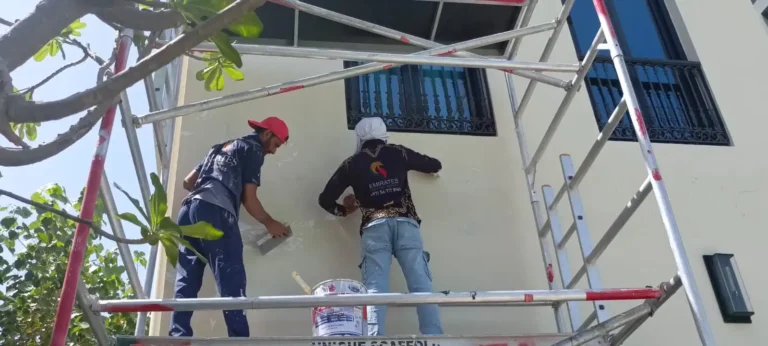
- High walls and multi-storey elevations require safe access equipment — scaffolding, tower scaffolds or elevated work platforms. Attempting to work from ladders on a two or three-storey villa facade is a significant safety risk.
- Correct product selection for Dubai’s climate requires familiarity with available systems. Applying an interior or mild-climate product to an exposed exterior facade in Dubai produces early and avoidable failure.
- Surface diagnosis — identifying what is behind visible symptoms before repainting begins — is a skilled step that determines whether the new paint will last or fail prematurely. DIY repainting commonly skips this step.
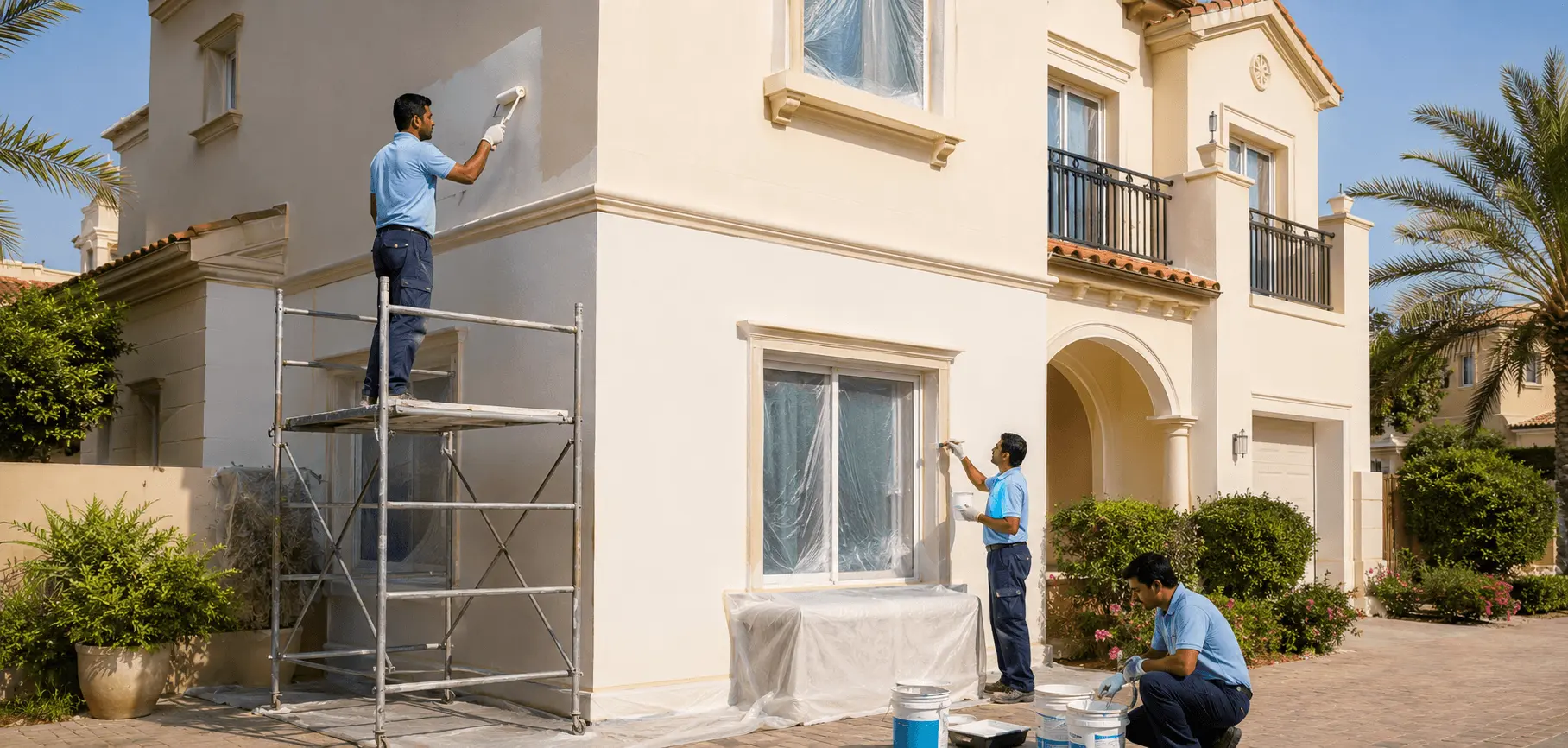
- Protection of landscaping, paving, pool surrounds and outdoor furniture during exterior painting requires a systematic approach. Professional contractors sheet and mask these as a standard step.
- Community access and documentation for villas in managed communities requires coordination that a professional contractor handles routinely.
Emirates Painting Services provides free site inspections, written quotations, full surface preparation and professional exterior villa repainting across Dubai.
Emirates Painting Services has delivered residential and commercial painting projects across Dubai for over a decade. The specific reasons villa owners choose them for exterior work:
Free villa exterior inspection — carried out on site by an experienced team member, with photographs and a clear recommendation before any commitment
Written, itemised quotation — surface preparation, materials, labour and repairs listed separately, so there are no surprises
Correct surface preparation — cracked, peeling and contaminated surfaces addressed before painting begins, not painted over
Dubai-appropriate paint systems — Jotun, Dulux and National Paints exterior products specified for the substrate, exposure and application requirements
Crack filling and minor render repairs included in scope — agreed and itemised before work starts
Protection of landscaping, paving and outdoor areas during exterior work — sheeted and masked as a standard step
Community access coordination for managed communities — permits, contractor documentation and working-hour compliance handled
Written warranty — duration, coverage and exclusions stated clearly alongside the quotation
Visit emiratespaintingservices.ae or call +971 56 717 8165 to arrange a free site inspection at your villa.
Before contacting a painting contractor, carry out your own walkround inspection. This gives you a clearer brief for the conversation and helps ensure nothing is overlooked in the scope.
- Walk around all four sides of the villa and inspect each elevation in daylight
- Note the condition of each wall — fading, chalking, peeling, cracks, staining
- Inspect walls in direct sunlight as well as shaded areas
- Look around all windows and doors for caulking failure and paint detachment
- Check parapets and boundary walls for cracks, staining and paint condition
- Examine gates, railings and metalwork for rust and coating failure
- Look for any blistering, bubbling or damp patches on any elevation
- Rub a clean hand on suspicious chalky surfaces and note the result
- Photograph all visible cracks, including their location and approximate width
- Identify any areas of damp, staining or recurring mould
- Check whether community or developer approval is required before exterior colour changes
- Request a professional site inspection and a written scope before agreeing to any work
- Confirm that the quotation itemises preparation, materials and labour separately
Protect Your Villa Before Minor Paint Damage Becomes a Bigger Repair
Faded paint is a signal. Chalking is a signal. Peeling, cracking, blistering, damp stains and rusting metalwork are all signals — and the longer they are left, the more likely the repair will involve the substrate beneath the paint rather than just the coating itself.
Not sure whether your villa needs a complete repaint or only repairs and touch-ups? Book a free villa exterior inspection — a clear recommendation based on the actual condition of your property, in writing, at no cost.