How Often Should You Repainta Villa or Apartment in Dubai?
Every other guide gives you a number. A repaint is triggered by condition, not by a date — and most Dubai homes need one zone repainted, not the whole property.
Search for how often to paint a house in Dubai and you will get a number. Three years. Five years. Seven. The numbers rarely agree, and none of them have seen your walls.
Here is the more useful answer: a repaint is triggered by condition, not by a date. Two identical apartments in the same building can be four years apart in when they genuinely need repainting — because one has a west-facing living room and a family of four, and the other is a north-facing unit occupied by one person who works long hours.
This guide gives you realistic planning intervals for interiors and exteriors, the Dubai-specific factors that shorten them, three tests you can run yourself in under a minute, and an honest view of when a full repaint is the wrong purchase.
Quick Answer: How Often Should You Repaint in Dubai?
As planning ranges only — not guarantees, and always subject to the condition of the actual surface:
| Surface | Typical Interval | What Actually Decides It |
|---|---|---|
| Interior — bedrooms, formal rooms | 5–7 years | Very low contact; usually colour preference, not wear |
| Interior — living and family rooms | 3–5 years | Furniture contact, cleaning, sunlight on one elevation |
| Interior — hallways, stairwells | 2–4 years | Constant hand and body contact; the first zone to fail |
| Interior — children’s rooms | 2–4 years | Marks, crayon, poster tape, changing taste |
| Interior — kitchens | 3–5 years | Grease, cleaning frequency, humidity |
| Ceilings | 6–10 years | Almost nothing touches them; stains drive replacement |
| Doors, frames, skirting | 3–5 years | Impact points — often need attention before the walls |
| Exterior — shaded elevations | 6–8 years | Lower UV load, but watch biofilm on damp walls |
| Exterior — sun-facing elevations | 4–6 years | UV and heat cycling; fades and chalks first |
| Exterior — boundary walls | 4–6 years | Irrigation contact at the base is the usual killer |
| Rental unit — between tenancies | Per handover | Driven by the tenancy agreement, not paint failure |
The Three Tests That Actually Answer the Question
Before you accept any interval, run these. They take about a minute each and they tell you more than the calendar does.
The Wet-Rub Test
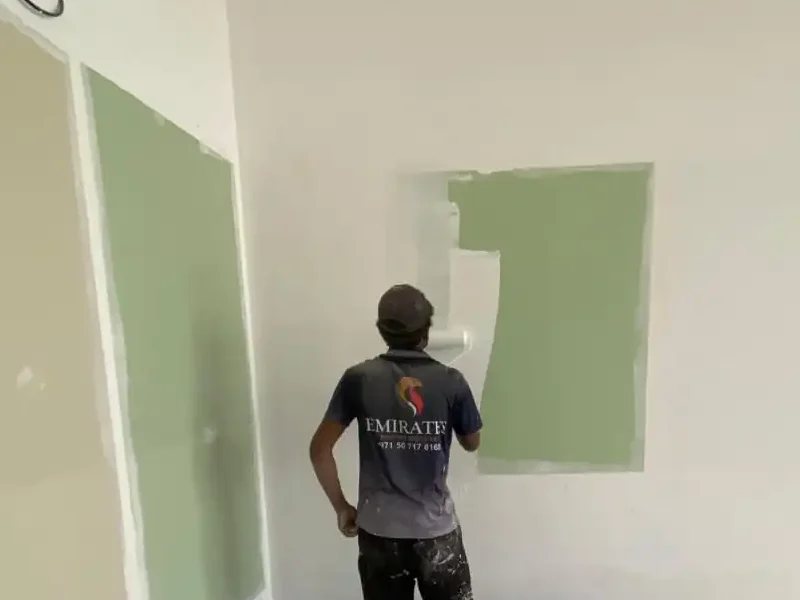
Rub a damp cloth firmly on an inconspicuous patch of wall. If it comes away chalky or carrying colour, the coating has broken down and is no longer bonded properly. That wall needs a stabilising primer — not simply another coat.
Interior & ExteriorThe Raking Light Test
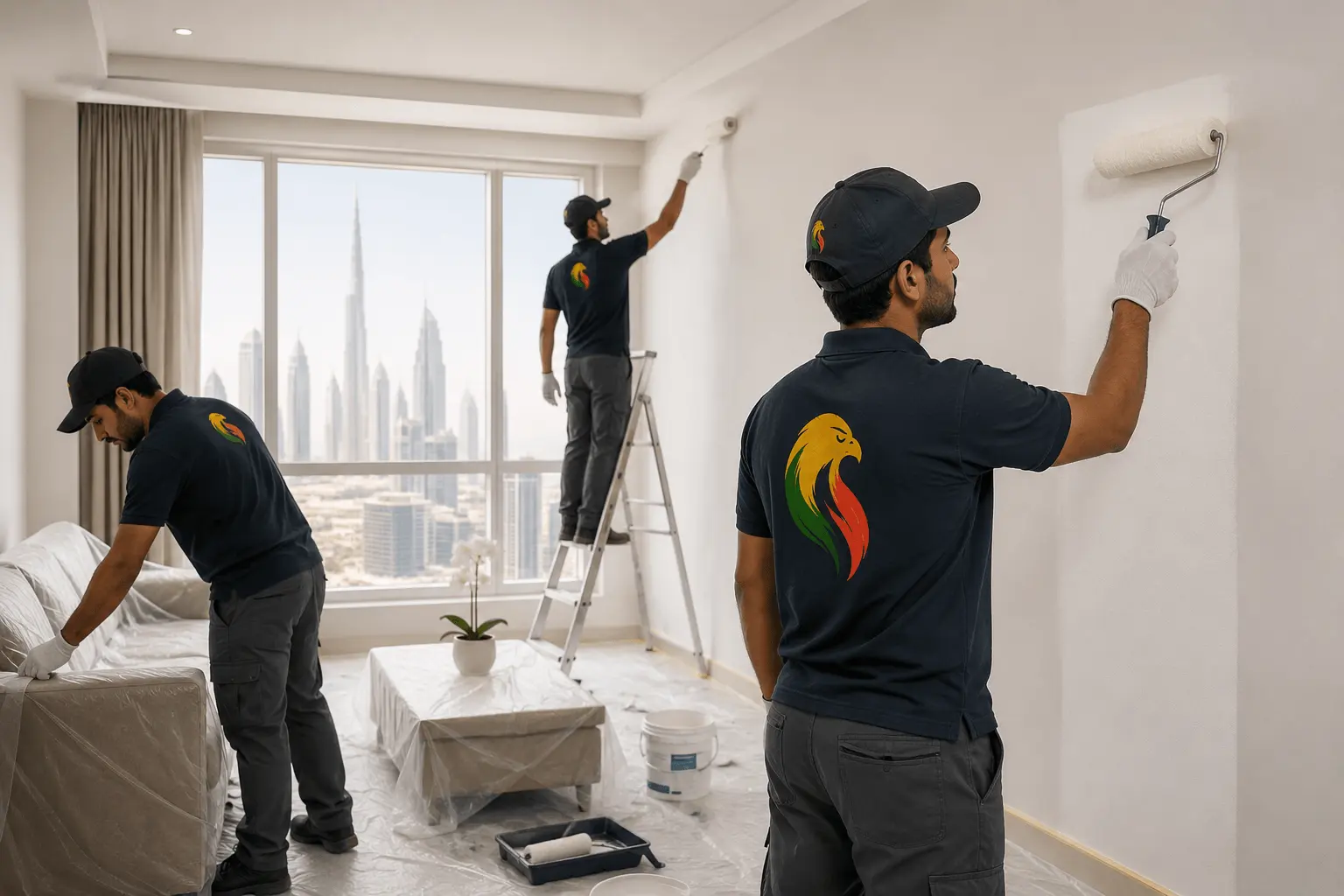
Turn off the ceiling light and shine a torch along the wall at a shallow angle, almost parallel to the surface. Ridges, old filler, roller texture and patch repairs all throw shadows that are invisible under normal lighting.
InteriorThe Elevation Walk
Walk the full perimeter in daylight and look at each elevation separately. Compare the sun-facing wall against the shaded one. In most Dubai villas the difference is obvious — and it tells you that you may need one or two elevations, not four.
ExteriorThe wet-rub test matters most on older buildings and sun-facing exteriors. It is also the single most common thing a cheap quote skips — see our guide to painting over old paint.
Why Dubai Shortens the Interval
Generic repaint advice is written for temperate climates. Five factors here compress the numbers, and they do not affect every property equally.
UV and Heat Cycling
Sustained UV degrades exterior coatings and fades saturated colours. Surfaces also expand and contract daily as temperatures swing, which opens hairline cracks in rigid films. West and south-facing elevations take the worst of it — see the best exterior paint for Dubai heat.
Air Conditioning and Condensation
Heavy cooling against humid outside air creates condensation at the weakest insulation points: around AC ducts, along ceiling bulkheads, in the corners of external-facing walls and behind furniture pushed flat against them. This produces dark spotting and peeling that people misread as paint failure. It is a ventilation problem, and repainting alone will not stop it recurring.
Dust
Airborne dust settles on exteriors constantly and embeds in textured render. It dulls colour long before the coating has genuinely failed — which means some “faded” walls only need a proper wash-down, not a repaint.
Irrigation
Sprinklers striking the base of a boundary wall drive moisture and dissolved salts into the render. The coating lifts from the bottom upward. Adjusting the sprinkler head is cheaper than repainting the wall twice.
Tenancy Turnover
In Dubai’s rental market, repainting is often triggered by a handover date rather than by paint condition. That is a legitimate reason to repaint — but it is a commercial trigger, not a technical one. See move-out painting in Dubai.
Ran the tests and still not sure?
Send photos of the areas you are concerned about — in ordinary light and, if possible, in side light. We will tell you which surfaces genuinely need repainting and which can wait.
Interior: Repaint the Zone, Not the Home
This is the part most guides get wrong. Interior wear is not evenly distributed, so repainting a whole property on a fixed cycle means paying to repaint surfaces that were still fine.
| Zone | Relative Wear Rate | Practical Consequence |
|---|---|---|
| Hallways and staircase walls | Highest | Repaint these alone and the whole home feels refreshed |
| Children’s bedrooms | High | Often driven by taste change as much as marks |
| Living and family rooms | Moderate | Usually one wall behind seating shows first |
| Kitchens | Moderate | Grease and cleaning rather than contact |
| Adult bedrooms | Low | Rarely the reason a home needs repainting |
| Ceilings | Very low | Replace when stained or yellowed, not on a cycle |
The Cheaper Strategy
Repaint the high-wear zones on a shorter cycle and the low-contact rooms on a longer one. Specify a scrub-resistant product in hallways and stairwells where it earns its cost, and a standard matt elsewhere. See our brand and product comparison for how ranges differ.
Exterior: Repaint the Elevation, Not the Villa
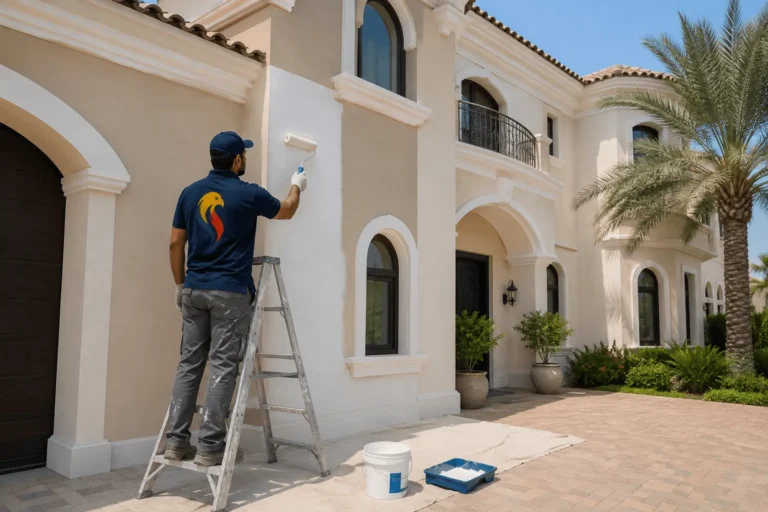
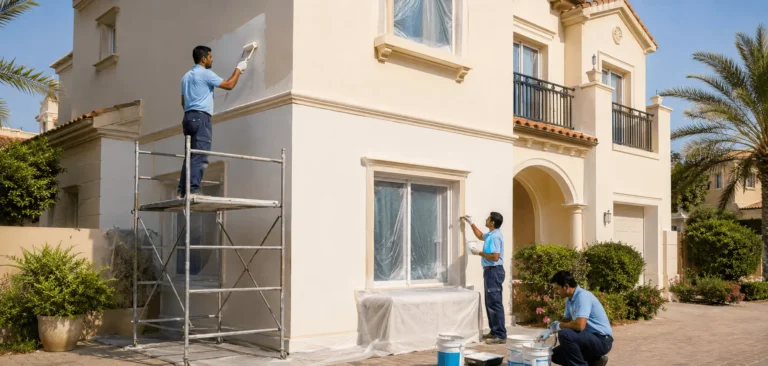
The same logic applies outside, and the saving is larger because exterior work costs more per square metre. A west-facing façade may be visibly faded and chalking while the north elevation is still sound. Repainting all four sides on the same cycle means paying for two or three elevations that had years left in them.
| Elevation | Main Stress | Usually Fails By |
|---|---|---|
| West-facing | Intense afternoon sun and heat | Fading, then chalking |
| South-facing | Sustained high UV load | Fading, hairline cracking |
| East-facing | Morning sun, moderate load | Slower fade |
| North-facing / shaded | Damp retention, low UV | Biofilm and green-black staining |
| Boundary wall base | Irrigation and salts | Coating lifting from the bottom up |
Full exterior scope and preparation detail sits on our exterior painting services page.
Villa vs Apartment: Different Drivers
| Factor | Villa | Apartment |
|---|---|---|
| Exterior responsibility | Yours — façades, boundary walls, gates | The building’s — you rarely paint outside |
| Main interior driver | Large sunlit walls, stairwells, majlis | Hallway contact, condensation near AC |
| Typical interval driver | Exterior UV exposure | Tenancy turnover or interior wear |
| Access constraints | Scaffolding for double-height areas | Service-lift booking and permitted hours |
| Community rules | Exterior colour approval may apply | Contractor registration usually applies |
| Repaint unit that makes sense | One or two elevations, or one floor | One or two rooms, or the hallway |
For scope and pricing detail see villa painting services and apartment painting services, or the villa painting cost guide and apartment painting cost guide.
Ten Signs It Is Time — Regardless of the Calendar
- Chalky residue on your hand after touching an exterior wall
- Visible fade against a sheltered reference area
- Peeling or flaking, particularly at edges and reveals
- A hallway or stairwell with a visible contact band
- Marks that no longer clean off
- Patch repairs reading as a different sheen or shade
- Green or black staining on a shaded exterior wall
- Coating lifting at the base of a boundary wall
- Yellowed or stained ceilings under downlights
- A colour scheme you no longer want to live with
When You Should NOT Repaint Yet
Five situations where repainting is the wrong next step, and doing it anyway means paying twice.
| Situation | Why Repainting Fails | Do This First |
|---|---|---|
| Active leak | Water returns through the new film within weeks | Find and fix the source |
| Persistent damp | Moisture pushes the coating off from behind | Diagnose the cause, allow drying |
| Visible mould | Paint conceals it; it returns and spreads | Address moisture, then remediate |
| Recurring or widening cracks | Filler reopens along the same line | Establish whether it is movement |
| Unstable or chalking coating | New paint bonds to a layer already failing | Stabilising primer, or removal |
Skipping to the last step is the most expensive shortcut in decorating.
Our guides to villa waterproofing and common painting mistakes in Dubai homes cover both in more detail.
How to Make a Repaint Last Longer
The interval is not fixed. These choices genuinely extend it.
At the Time of Painting
- Insist on preparation being itemised in the quotation — the single biggest factor in how long the finish lasts
- Use a scrub-resistant product in hallways, stairwells and children’s rooms; accept standard matt elsewhere
- Ask what primer is specified and why — on a repaint it is not always needed, but where it is, skipping it shortens the life substantially
- Specify moisture-tolerant, anti-fungal products in kitchens, bathrooms and poorly ventilated rooms
- Record the manufacturer, product, colour code and finish — this is what makes future touch-ups invisible
Afterwards
- Let the coating cure fully before washing it — check the data sheet rather than testing by touch
- Pull furniture a few centimetres off external walls so air can circulate behind it
- Adjust irrigation so sprinklers do not strike the base of boundary walls
- Clean marks early with a mild product rather than scrubbing hard later
- Touch up chips and scuffs before they spread — matching paint on file makes this a ten-minute job
- Deal with leaks and condensation promptly, before they reach the paint film
What a Repaint Quotation Should Specify
If you are comparing quotes, these are the lines that make two prices genuinely comparable.
- Exact rooms, walls or elevations included — and what is excluded
- Preparation: filling, sanding, washing, loose-coating removal
- Repairs included, and what would be charged separately
- Primer specification, and where it is being applied
- Paint manufacturer, product range, colour code and finish
- Number of coats
- Furniture, flooring and fixture protection
- Access equipment where needed
- Cleanup and waste removal
- Estimated duration
- Warranty terms and exclusions, in writing
- Whether VAT is included
Frequently Asked Questions
How often should you paint a house in Dubai?
How often should you repaint an apartment in Dubai?
How often does a villa exterior need repainting in Dubai?
What is the lifespan of interior paint in Dubai?
Can I repaint just one room or one wall?
Does repainting increase my property value?
Should I repaint before selling or renting?
How long does repainting take?
Do I need to move out while my home is repainted?
Is it cheaper to repaint more often or wait longer?
How do I know if my walls need primer?
What if my exterior has faded on only one side?
Conclusion
The useful answer to how often you should repaint in Dubai is not a number. It is a method.
- Run the wet-rub test and the raking light test indoors
- Walk the elevations outside and compare them against each other
- Identify which zones have genuinely worn — usually far fewer than you expect
- Check nothing needs repairing before decoration
- Then repaint that scope, and record the specification for next time
Not Sure Which Category Your Walls Fall Into?
Send photos of the areas you are concerned about — in ordinary light and, if possible, in side light. We will tell you which surfaces genuinely need repainting, which can wait, and whether anything should be repaired first. Free assessment, no obligation.